
You want to know whether ChatGPT, Perplexity or Google's AI results mention your brand, and you find a list of 22 tools for it. Most of them do the same basic thing: run a set of prompts and count who gets named. The best AI visibility tools for you differ in which engines they cover, how they run the prompts, and what they let you do with the results. Start from your job, not from the list.
If you only read this
- A quick check is free or close to it; ongoing tracking is a paid tool.
- If you already pay for an SEO suite, try its AI visibility add-on first.
- Compare on six things: engines, prompts, how prompts are run, citations, competitors, export.
- Two tools can disagree, because AI answers vary from run to run.
Below: what these tools measure, four jobs and the kind of tool for each, a six-point comparison table, and one open question: why two tools give you different numbers for the same brand.
How we wrote this. Spreadator is a growth marketing agency, and we run AI visibility checks as a service, so we care how these tools measure. We don't sell any of the tools below and this post has no affiliate links. Every tool named here comes from Google's page 1, its AI Overview or its related searches for "best ai visibility tools" in the US on 11 Nov 2026, and each one was checked on its own website that day. Plans change often, so we describe them in words and link each tool's own pricing page.
What an AI visibility tool actually measures
An AI visibility tool sends a list of questions (prompts) to AI engines, saves the answers, and counts what is in them. Five numbers come out of that, and each tool weights them differently.
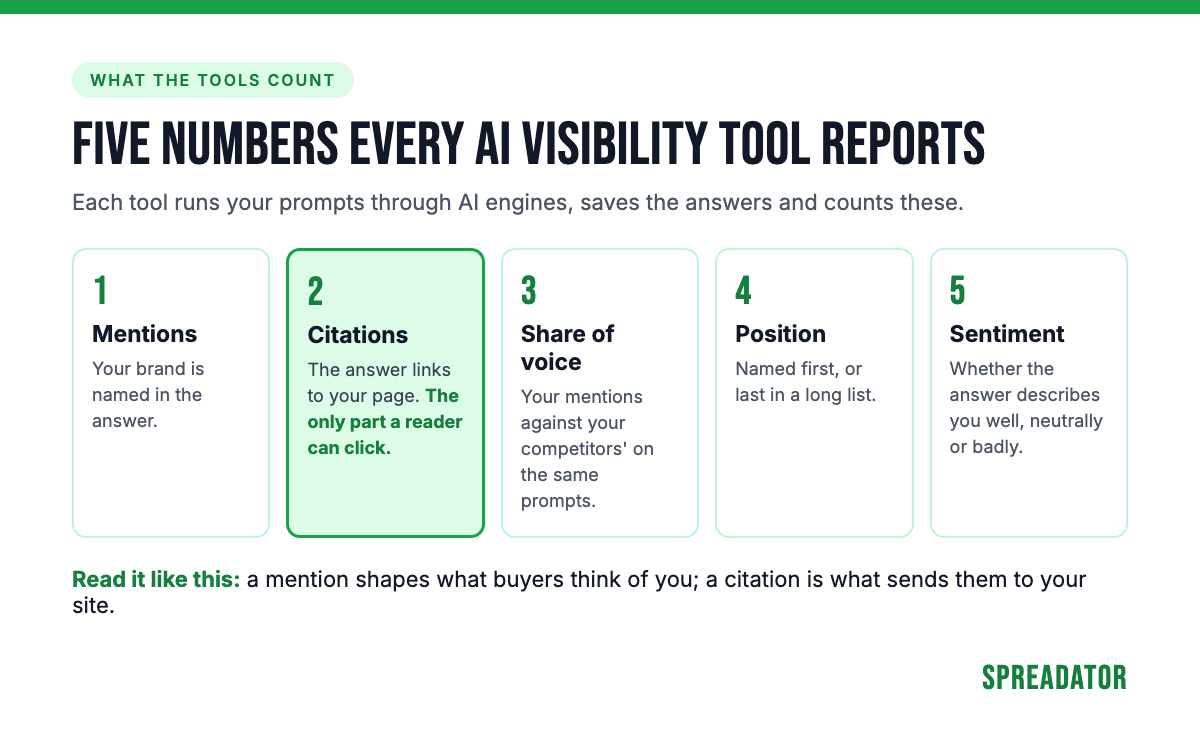
- Mentions: your brand is named in the answer.
- Citations: the answer links to one of your pages as a source.
- Share of voice: your mentions as a part of all brand mentions on the same prompts, so you see where competitors are named instead of you.
- Position: whether you are the first brand named or the last.
- Sentiment: whether the answer describes you well, neutrally or badly.
Citations matter most for traffic, because a link is the only part of the answer a reader can click. A mention without a citation still shapes what buyers think of you.
All of this sits under AI search optimization, the work of getting a business found and cited when people search with AI. Its parts have their own names: generative engine optimization (GEO) aims to get you cited inside written answers, and answer engine optimization (AEO) aims to make you the direct answer. Our guide to GEO covers both. If you want the tracking done and acted on for you, see our AI search optimization service.
Four jobs, four kinds of tool
Whichever AI search visibility tool you end up with, you are buying it for one of four jobs. The table names tools for each, all from the 11 Nov 2026 search results and all checked on their own sites that day.
| Your job | Kind of tool | Tools to look at |
|---|---|---|
| A one-off check of where you stand | Free grader or checker | HubSpot AI Search Grader, Semrush's free AI search visibility checker |
| Tracking inside the SEO suite you already use | Add-on or plan feature of an SEO suite | Semrush AI Visibility Toolkit, SE Visible (SE Ranking), Surfer AI Tracker |
| Ongoing tracking for an in-house team | Dedicated AI visibility tracker | Profound, Peec AI, Otterly.AI, ZipTie |
| Many brands or clients | Tracker with client projects and shared reports | Rankability, Keyword.com, LLMrefs |
A one-off check: a free grader
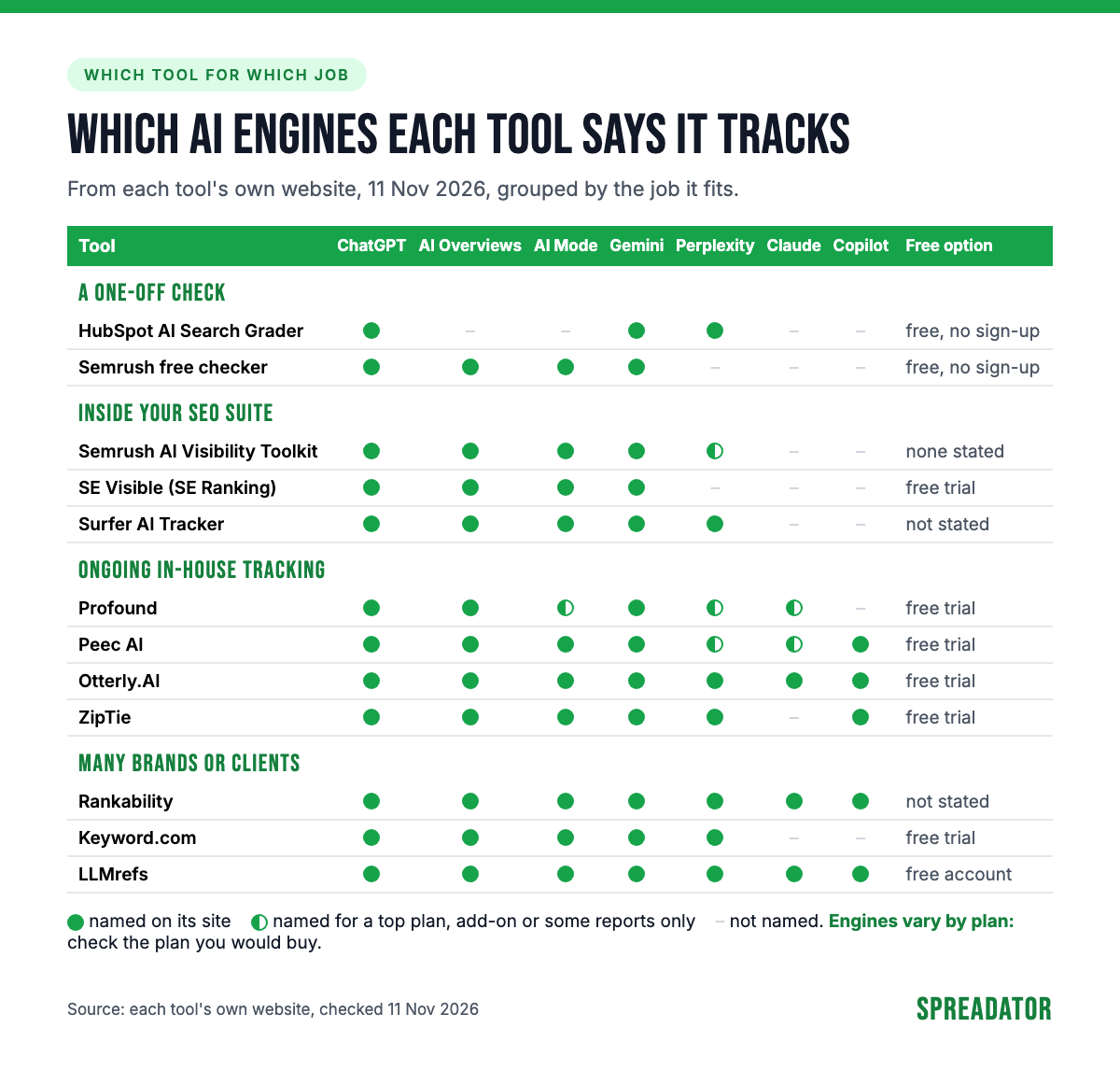
HubSpot's AI Search Grader is a free, one-time check of what ChatGPT, Perplexity and Gemini say about your brand, with no account needed. It scores sentiment, share of voice and how well the engines know you.
Semrush's free AI search visibility checker reports mentions, citations and a competitor comparison across ChatGPT, Gemini and Google's AI Mode and AI Overviews, without signing up. Either one tells you in a few minutes whether you have a problem.
Tracking inside the SEO suite you already use
The Semrush AI Visibility Toolkit is a paid subscription you add to Semrush, or get inside its Semrush One plans; its help pages say there is no free trial for it. It covers ChatGPT, Gemini, Google AI Mode and AI Overviews, with Perplexity in its brand reports, and adds sentiment, competitor research and CSV export.
SE Visible, from the SE Ranking team, tracks Google AI Mode, AI Overviews, Gemini and ChatGPT, shows which domains and URLs get cited, and includes an API on every plan, with a free trial.
Surfer's AI Tracker covers ChatGPT, Gemini, Perplexity, Google AI Mode and AI Overviews; Surfer's lower plan tracks ChatGPT only.
Ongoing tracking for an in-house team
Profound (people often search "Profound AI") is built for larger brands: it names ten AI engines on its home page, including ChatGPT, Perplexity, Claude, Gemini and both Google AI features, with citation analytics and sentiment. Its free trial covers ChatGPT, Gemini and Google's AI Overviews; the full plan, sold through a demo, adds the rest.
Peec AI lets you pick which engines to track from a list that includes ChatGPT, Gemini, Copilot and Google's AI features, adds Perplexity and Claude on its top plan or as add-ons, and has a free trial, CSV export and an API.
Otterly.AI (searched as "Otterly AI") tracks ChatGPT, Google AI Overviews and AI Mode, Gemini, Copilot, Claude and Perplexity, with citations and competitor reports, and a free trial.
ZipTie tracks up to seven engines, including Bing's AI results, shows which answers cite you, and has a free trial.
Many brands or clients
Rankability lists more than ten engines for its tracker, measures citation rate and share of voice, and shares read-only client reports by link.
Keyword.com sells its AI rank tracker as an add-on to its rank tracker, covers five engines and offers white-label, read-only dashboards for clients, with a free trial.
LLMrefs names more than ten engines, organizes projects by client, exports CSV, has an API, and lets you open a free account.
Compare any two tools on these six points
Feature lists are long; six points decide most purchases. Check each one on the tool's own site and pricing page, because the answer often depends on the plan.
| Point | What to ask | Why it matters |
|---|---|---|
| Engines covered | Which engines, on the plan you will buy? | Several tools put Perplexity or Claude on higher plans only. |
| How many prompts | How many questions are tracked, how often? | More prompts, run more often, smooth out the run-to-run changes in answers. |
| How prompts are run | Through an engine's API, or the app a person uses? | An API answer is not always what a buyer sees in the app; Peec AI's pricing page labels its API-based engines. |
| Citations and source URLs | Does it show which pages each answer links to? | Sources tell you which pages to improve or which sites to get listed on. |
| Competitor tracking | Can you add your own competitors? | Share of voice needs a fixed set of competitors. |
| Export and API | CSV, API, a dashboard connector? | You will want the data next to your SEO and analytics reports. |
Why two tools give you different numbers
AI answers change from one run to the next, so any single check is a sample. A 2026 study by SparkToro and Gumshoe ran the same prompts through ChatGPT, Claude and Google's AI results many times: the same list of brands came back less than 1% of the time, and the same list in the same order less than 0.1% of the time (SparkToro, 2026). The set of brands that appeared was steadier than the lists themselves. Gumshoe sells AI tracking, which the study discloses.
Answers also change with location, account, time and the exact wording of the question. Tools differ in all of these: which country they ask from, whether they run each prompt once or several times, and whether they use an API or the app. So one tool may show your brand in most answers and another in fewer than half, and both can be honest.
What to do about it: compare a tool with itself over time, not with another tool. Watch the trend across many runs, not one day's number. When you test two tools, give them the same prompts, competitors and country.
When the free check is enough
A small business checking 10 questions once a quarter does not need a paid tool. Ask your buyers' 10 main questions in ChatGPT, Gemini and Google's AI results, note who is named and which pages are cited, and run a free grader for a second view. That is 30 answers to read, which fits in an afternoon.
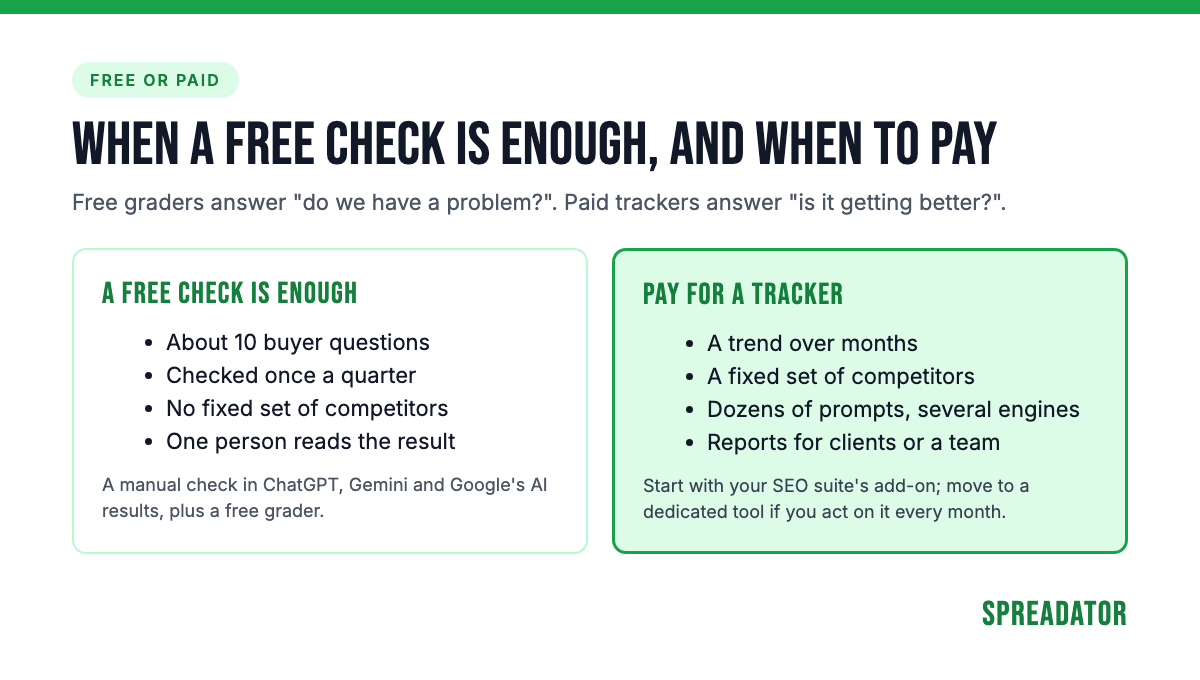
Paying starts to make sense when you need three things the free checks don't give: a trend over months, a fixed set of competitors, and dozens of prompts run often enough to smooth out the run-to-run changes above. Agencies add a fourth: reports each client can open on their own.
Our take
Most teams should start with the add-on in the SEO suite they already pay for. It sits next to the rankings and traffic data you already read, and it costs the least to try. Move to a dedicated tracker only if you act on the data every month: new pages, updated pages, outreach to the sites that get cited.
Pick by engines and method before features. If your buyers use Perplexity or Claude, check that the plan you will buy covers them. If the tool doesn't say how it runs prompts, ask before you pay.
Don't buy a tracker to find out whether you have a problem. A free check answers that. A tool nobody reads is the most expensive kind.
Choosing between the best AI visibility tools for your team
Answer four questions and the list of 22 tools gets short.
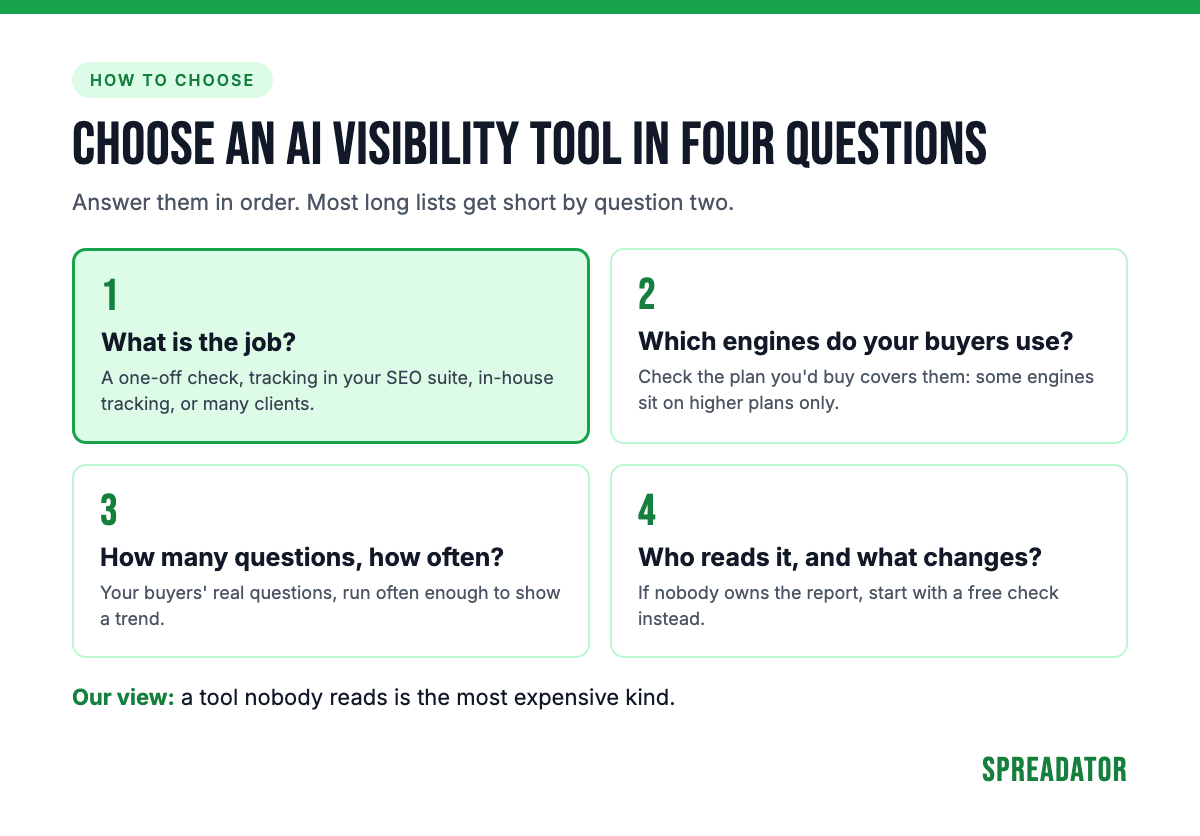
- What is the job? A one-off check, tracking inside your suite, ongoing in-house tracking, or many clients.
- Which engines do your buyers use? Check that the plan you would buy covers them.
- How many questions, how often? Your buyers' real questions, run often enough to see a trend.
- Who reads the report, and what will they change? If nobody owns it, start with the free check.
If you want a second view before you commit to a tool, ask us for an AI visibility check. We check where your brand appears, or doesn't, in ChatGPT, Gemini, Perplexity and Google's AI results for your main searches, and tell you what to fix first, whichever tool you choose. We also help with the SEO groundwork these engines rely on and with AI analytics to measure the results. Ask us for an AI visibility check.
FAQ
What are the best AI visibility tools?
The best one depends on your job. For a one-off check, use a free grader such as HubSpot's AI Search Grader. If you already pay for Semrush, SE Ranking or Surfer, try their AI tracking first. For ongoing in-house tracking, look at Profound, Peec AI, Otterly.AI or ZipTie; for many clients, Rankability, Keyword.com or LLMrefs.
Are there free AI visibility tools?
Yes, for one-off checks. Most of what you find when you search for AI visibility tools free of charge is a grader: a free AI visibility checker such as HubSpot's AI Search Grader or Semrush's free checker, both of which work without an account. LLMrefs lets you open a free account, and most paid trackers offer a free trial. Ongoing tracking with trends and competitors is almost always paid.
How do AI visibility tools work?
They send a fixed list of prompts to AI engines on a schedule, save each answer, and count which brands are named and which pages are cited. From that they report mentions, citations, share of voice against your competitors, position and sentiment.
Which AI engines should I track?
Track the engines your buyers use. For most US businesses that means ChatGPT and Google's AI Overviews and AI Mode, then Gemini and Perplexity. Add Claude or Copilot if your buyers work in those tools, and check that the plan you buy covers them.
Why do AI visibility tools show different results?
AI answers change from run to run, and tools ask from different places, with different settings and different numbers of runs. A 2026 SparkToro study found the same brand list came back less than 1% of the time across repeated runs. Compare a tool with itself over time, not with another tool.