
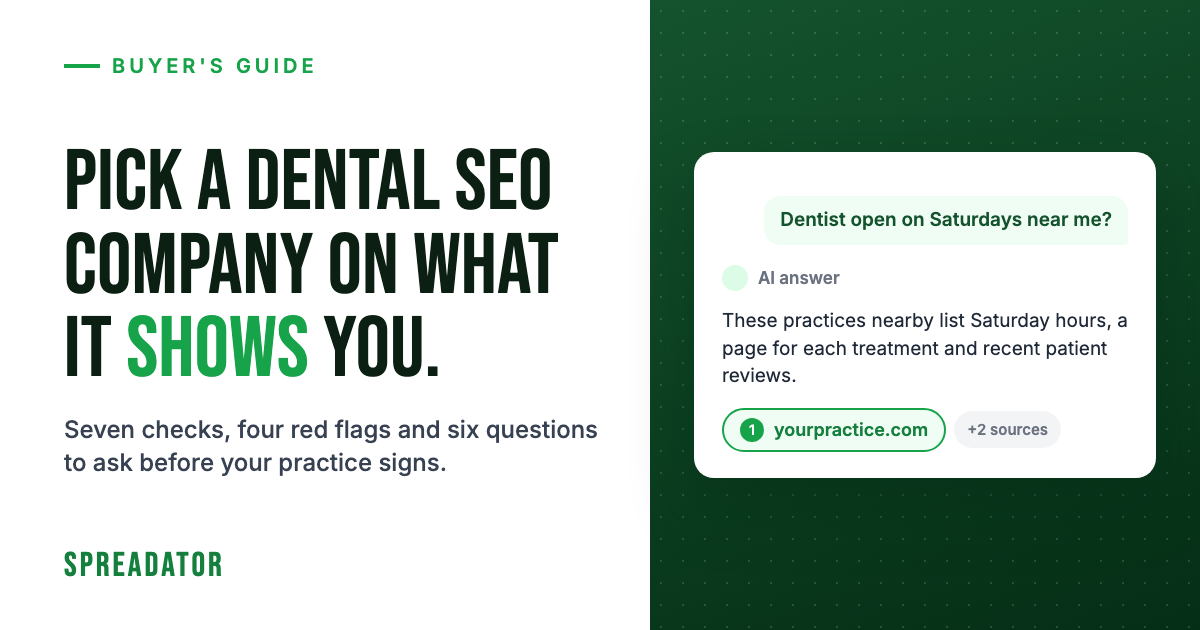
You search for the best dental SEO companies and get lists of 20, 25 and 32 names, most of them written by marketing firms. You don't need 32 names. You need a dental SEO company that does the work your practice needs and shows you the results in booked appointments. This guide names no companies. It gives you checks you can run on any of them, ours included.
Disclosure. Spreadator wrote this. We're a marketing agency that offers SEO, so we're not neutral. We aren't a dental-only agency. That's why this guide names no companies and gives you checks you can run on anyone.
If you only read this
- Your practice must own its Google Business Profile, website, domain and analytics.
- Ask for reports in calls and booked appointments, not rankings.
- Walk away from guarantees, and from anyone who asks only happy patients for reviews.
- Read the contract length and exit terms before you sign.
Below: what the work is, seven checks, what we found when we ran them on page 1, the red flags, six questions and how these companies charge. And one open question: why a review program can put your practice at risk.
What a dental SEO company should do for your practice
A dental SEO company works to get your practice found by patients searching nearby: in the map results, in ordinary search and, more and more, in AI answers. Our dental SEO guide covers the six parts of that work in the order we'd fix them. In short:
- Your local listing: the Google Business Profile, and the same name, address and phone everywhere.
- A page per treatment: implants, aligners, emergency visits, each with its own page.
- Reviews: a steady, honest flow, and a reply to each one.
- Technical health: a site that loads fast on a phone and that Google can crawl.
- Measurement: calls, bookings and direction requests.
If a proposal skips the listing and the treatment pages and starts with a blog post a week, ask why. It's the same order our local business marketing work follows.
Seven checks to run on any dental SEO company
Answer these from the company's own website before the first call. They take a few minutes per company:
- Method in public. Does its dental SEO page explain how it does the work, step by step?
- Local and Maps work. Does it name Google Business Profile work: categories, services, photos, location pages?
- A page per treatment. Does it build or rewrite treatment pages, reviewed by a dentist?
- Reviews within the rules. Does it ask every patient, not only the happy ones?
- Reports in booked appointments. Does it report calls and bookings, not only rankings?
- Contract in writing. Will it put the term, the exit and who owns the site and listing in writing?
- No guarantees. Does it avoid promising rankings, patients or results by a date?
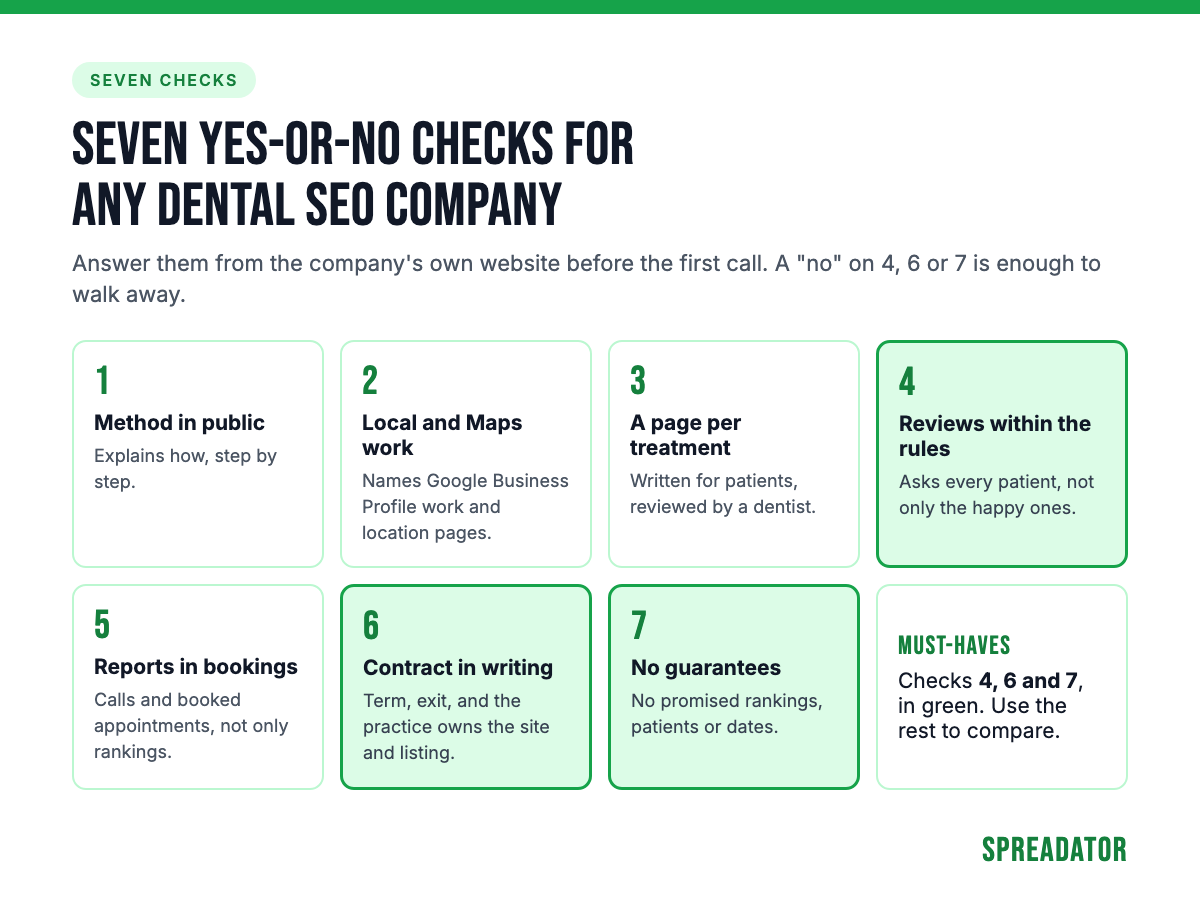
Treat 4, 6 and 7 as must-haves. A "no" on any of them is enough to walk away: they are where a practice takes on risk it can't see in a sales call. Use the other four to compare the companies that pass.
What page 1 shows when you run the checks
Most dental SEO company pages talk about booked patients; almost none say what you sign. On 11 Nov 2026 we ran the checks on the agency service pages that appeared on Google's page 1 (US) for "dental seo company" on 14 Oct or 11 Nov 2026. Three of the nine blocked our reader, so the counts are out of six:
- 5 of 6 say they report booked appointments or new patients.
- 3 of 6 name Google Business Profile work.
- 2 of 6 explain their method step by step.
- 1 of 6 says it builds a page per treatment.
- 2 of 6 use the word "guarantee" about patients or growth.
- 0 of 6 state contract length, exit terms or who owns the site and listing.
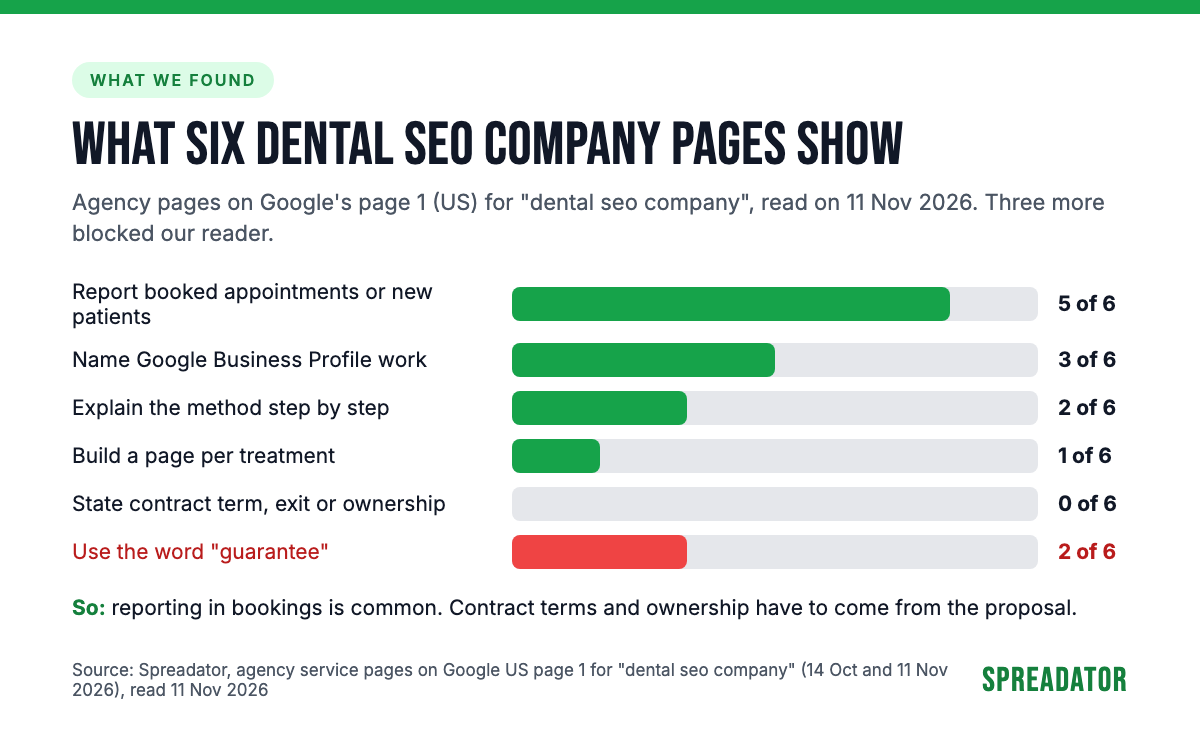
So read the page, then ask for the rest in writing. Reporting in bookings is now common; a written scope, term and ownership clause are not on the page, so they have to come from the proposal.
Reviews: what the FTC and Google allow
This is the open question: a review program can break the rules even if every review is real. Most of the pages we read promise more reviews. None said how it asks for them.
Google's rules. Google's policy for Maps reviews says merchants may not "discourage or prohibit negative reviews, or selectively solicit positive reviews from customers", and may not offer payment, discounts or free services in exchange for reviews (Google, Prohibited and restricted content, read 11 Nov 2026). A tool that sends unhappy patients to a private form and happy ones to Google does exactly what that first line forbids. That practice is called review gating.
The FTC's rule. The FTC's rule on consumer reviews and testimonials took effect on 21 October 2024 (FTC press release, 14 Aug 2024). It bans fake reviews, buying positive or negative reviews, undisclosed reviews from staff and review suppression through threats, and lets courts impose civil penalties for knowing violations. FTC staff say the rule has no specific ban on asking only satisfied customers, "but this practice could violate the FTC Act" (FTC questions and answers, read 11 Nov 2026).
What to ask. Who gets the review request, how, and what happens to a patient who reports a bad visit? The right answer: every patient gets the same request, and the practice still talks privately to anyone who had a bad experience. Our reputation management work is set up that way.
Red flags when you hire a dental SEO company
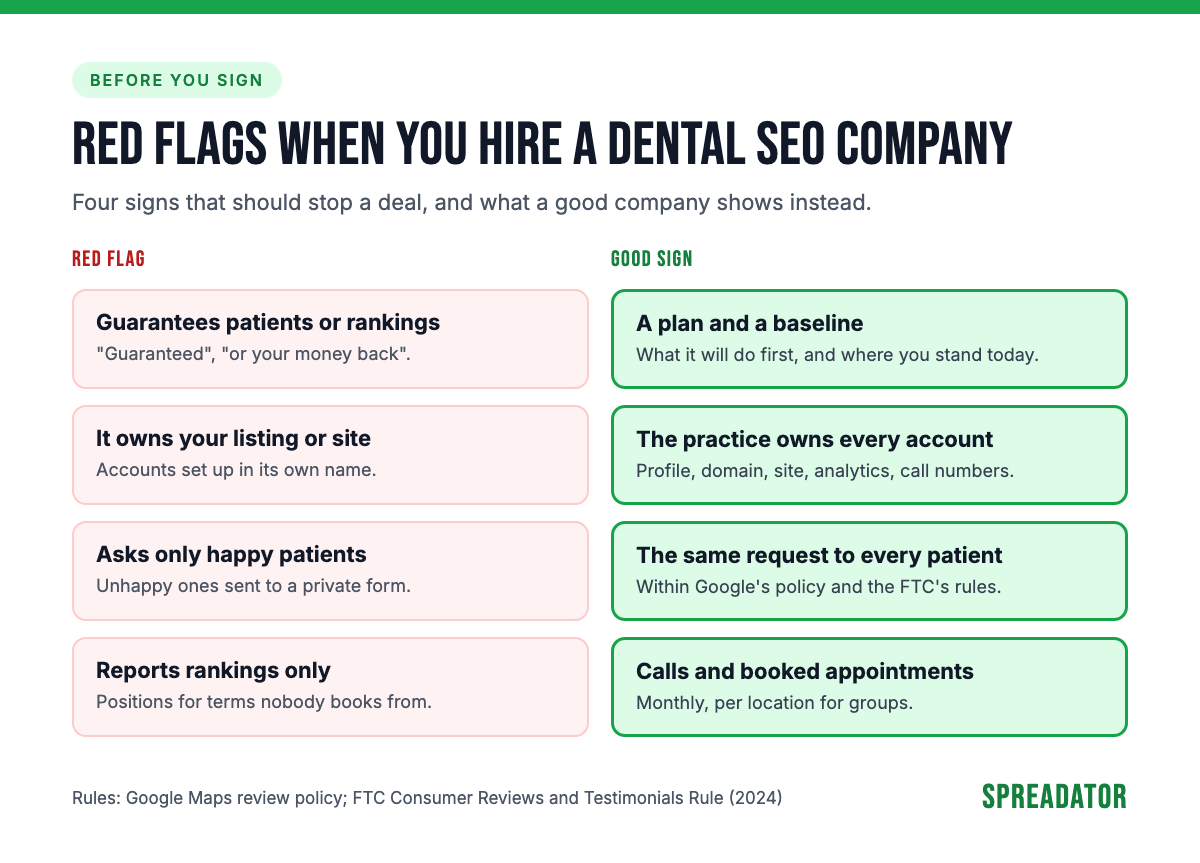
Four signs should stop a deal:
- It guarantees patients or rankings. One page-1 company we read says "We guarantee you new patients booked from SEO or your money back"; another heads its page "Grows Your Practice. Guaranteed." Nobody controls Google's results. A money-back promise usually comes with conditions; read them.
- It owns your listing or your site. If the company creates your Google Business Profile, domain or analytics under its own account, leaving means starting over.
- It asks only happy patients for reviews. See the rules above.
- It reports rankings only. A ranking for a term nobody books from proves nothing. Ask for calls and appointments.
Questions to ask on the first call
Six questions sort a real method from a sales deck. Ask them on the call, and ask for the answers in the proposal:
- Who does the work? A named dental SEO expert or team, and whether any of it is outsourced.
- What will you do first, and in what order? Scope and tasks, not promised results.
- Who owns what? The Google Business Profile, the domain, the site, the analytics, the call-tracking numbers.
- How do you report? Calls, booked appointments and direction requests, monthly.
- How does tracking handle patient data? Call recordings and booking forms may hold health information; ask how it is stored and who sees it, and check with whoever handles HIPAA compliance at your practice.
- How long is the contract, and how do we exit? The minimum term, the notice period and what you keep.
Dental specialist or general SEO agency?
A dental-only agency knows the patterns; a general agency may be stronger on the site itself. A specialist has written implant and aligner pages before, knows practice software and booking tools, and talks your language. A general SEO agency often brings deeper technical skill for a slow or broken site, and more experience with content beyond dentistry.
- Choose a specialist if your site works and you need listings, treatment pages and reviews done well.
- Choose a general agency with dental work it can show if your site has technical problems, or you run a group with complex needs.
Either way, the seven checks apply. A "dental" label on the home page is not a method. Our SEO service is general, not dental-only, so judge us on the checks too.
What dental SEO companies charge, and how they price
We don't quote figures: prices change, and a number from one company's page tells you little about your practice. On 11 Nov 2026, 3 of the 6 pages we read published a price or range. What you pay depends on:
- Locations: each office needs its own listing, page and review flow.
- Treatment pages: how many need writing and dentist review.
- Site work: whether the site needs technical fixes or a rebuild.
- Competition: a dense city takes more work than a small town.
- Extras: ads, call tracking and review software are often priced separately.
The pricing models you will meet: a monthly retainer, a price per location for groups, and a setup fee for the first audit and fixes. Ask two or three companies for written proposals with the same scope, priced per part, so you compare like with like.
Our take
For a single practice, a company that fixes your listing, your treatment pages and your reviews well is worth more than one with a big content plan. Those three do most of the work in local search, and you can see the effect in calls.
A multi-location group should insist on location-level reporting: calls and bookings per office, not one total. A strong office can hide a weak one in a combined report.
And whoever you hire, keep the accounts in the practice's name. That one clause protects you more than any guarantee.
FAQ
What does a dental SEO company do?
It works to get your practice found by nearby patients in map results, ordinary search and AI answers. The work covers your Google Business Profile, a page per treatment, reviews, site speed and crawlability, and reporting in calls and bookings.
How do I choose the best dental SEO company?
Run seven checks on its website: a public method, local and Maps work, treatment pages, reviews within the rules, reports in booked appointments, a written contract that leaves you owning your accounts, and no guarantees. Then compare written proposals with the same scope.
How much does a dental SEO company cost?
It depends on the number of locations, how many treatment pages you need, how much site work is required and how competitive your area is. Expect a monthly retainer, a per-location price or a setup fee. Ask for each part priced separately.
Should I pick a dental-only SEO company?
Not necessarily. A dental specialist knows treatment pages and practice software; a general SEO agency may be stronger on technical problems. Pick on the checks, not the label.
How do I check dental SEO company reviews?
Read reviews on independent sites, not only the company's own testimonials page, and ask to speak to a current practice client. Ask how the company gets reviews for its own clients: if it asks only happy patients, it may do the same for you.
Choosing a dental SEO company for your practice
Tell us what you want to grow: more new patients, more implant cases, or a new location. Before you sign with anyone, we'll review your practice's search presence, from your listing and reviews to your treatment pages, and tell you what to fix first, so you can judge every proposal against it. See what our SEO service covers and our local business marketing work for groups, then contact us.
Or ask us for an AI visibility check to see whether ChatGPT, Gemini and Google's AI results name your practice when patients ask for a dentist.