
You asked ChatGPT for 20 meta descriptions and got 20 that sound the same. ChatGPT SEO starts there: it's a fast assistant for SEO busywork, and a poor judge of what ranks, because it doesn't work from search data. "ChatGPT SEO" also means something else: getting your site named in ChatGPT's own answers. This post covers both.
If you only read this
- Use ChatGPT for ideas, grouping, outlines and first drafts of meta tags and schema. Check everything.
- Don't use it for search volumes or "what ranks": confirm those in a keyword tool and on the live results page.
- Google's spam policies target scaled, low-value content, however it was written.
- To show up in ChatGPT: let OpenAI's search crawler in, answer questions plainly, and get mentioned on sites people trust.
Below: five jobs ChatGPT does well, three where it goes wrong, and one open question: why a page can rank on Google and still not be cited by ChatGPT.
Two meanings of "ChatGPT SEO"
People mean two different jobs by the same words. On 11 Nov 2026, 6 of the 8 organic results on Google's US page 1 for "chatgpt seo" were about using ChatGPT for SEO. One covered both, and one was about ranking in ChatGPT. Google's own AI Overview, above them, read the phrase the other way: as getting ChatGPT to cite your site.
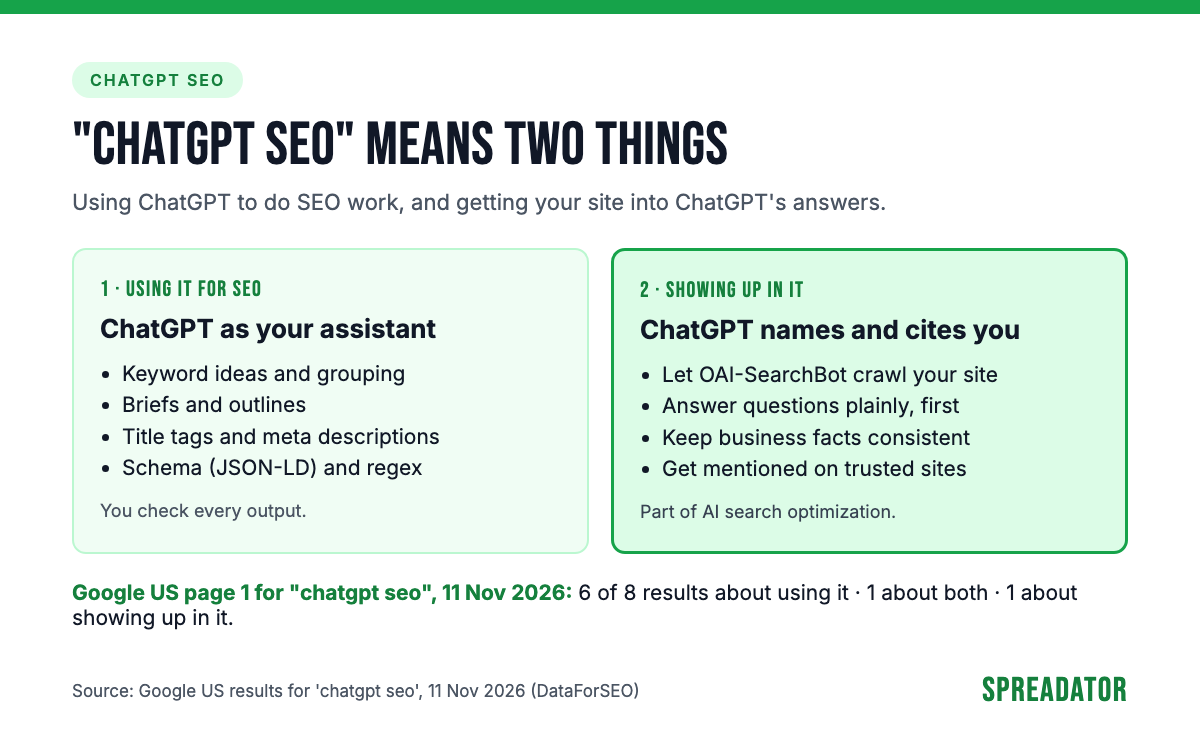
- Using ChatGPT for SEO is a productivity question: which tasks it speeds up, and which it gets wrong.
- Showing up in ChatGPT is part of what we call AI search optimization: making your site and your reputation easy for AI tools to find, trust and cite. One piece of it is generative engine optimization (GEO), the work of getting cited inside answers that AI tools write. Our guide to GEO explains the terms; this post sticks to ChatGPT.
We cover using it first, then showing up in it.
Five SEO jobs ChatGPT does well, each with a check
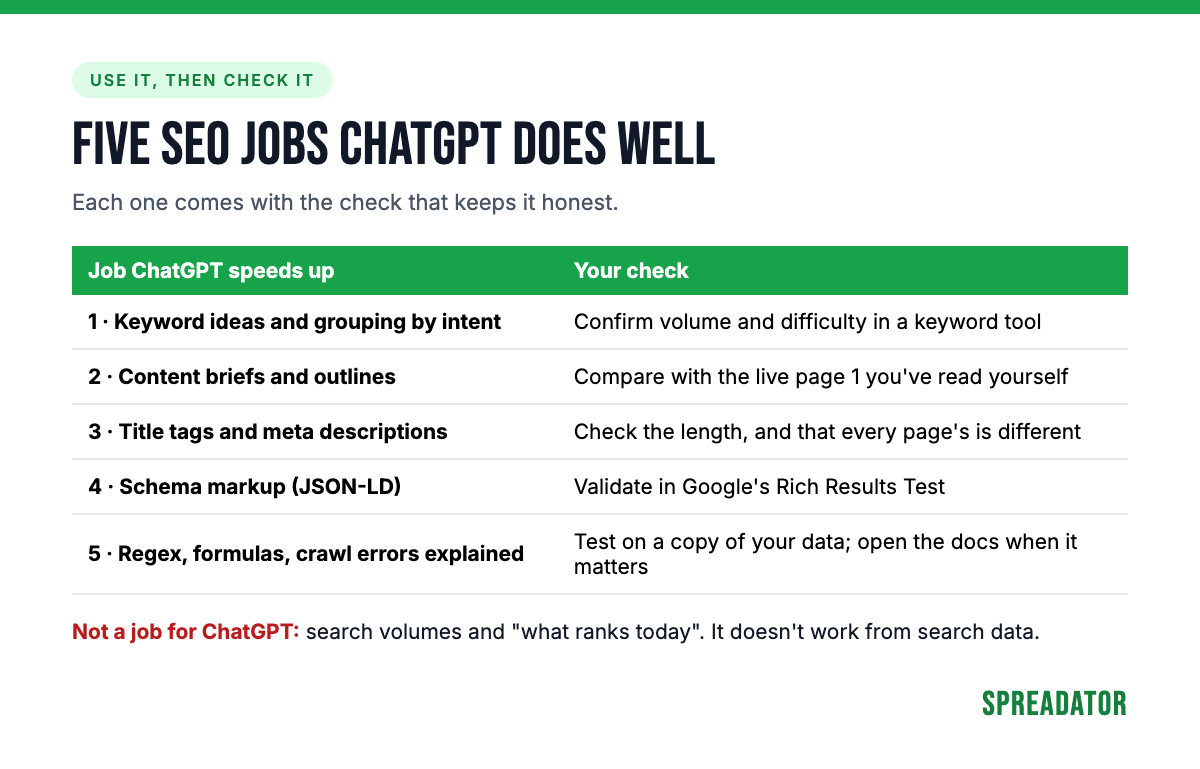
ChatGPT is good at turning messy input into a tidy first draft. It is not good at knowing what people search for or what Google ranks. So every job below pairs a task with the check that keeps it honest.
Keyword ideas and grouping: useful, with a check
Use it to widen a seed list and sort it by intent, then confirm every number elsewhere. A prompt that works:
"I run a dental clinic in Austin. List 40 searches a new patient might type before booking, grouped by intent: research, comparing clinics, ready to book. Don't give search volumes."
You get a broader list than you'd write alone, in the patient's words, already grouped. What you don't get is demand. Search volume and difficulty come from a keyword tool, not from ChatGPT; OpenAI doesn't describe ChatGPT as having a keyword database, so treat any volume it offers as a guess. Paste the list into your keyword tool and keep the searches with real demand.
Briefs, outlines and meta tags
Generic prompts give generic copy. Context is what changes the output. Compare two prompts for the same page:
| Before | After |
|---|---|
| "Write a meta description for our teeth whitening page." | "Write 3 meta descriptions, 140–155 characters, for a teeth whitening page at a clinic in Austin. The reader is comparing in-office and at-home whitening. Page 1 results all lead with price; lead with how long results last instead. No exclamation marks." |
The first prompt produces the copy everyone else gets. The second gives it your reader, your keyword, what page 1 already says and a reason to be different. The same applies to outlines: paste in the headings of the top results you've read yourself, and ask what's missing, not "write an outline". Then you choose, edit and check the length.
If you write a lot of content this way, set rules for it once: what ChatGPT drafts, what a person rewrites, and who checks the facts. Our AI content creation service runs on that split.
Schema and technical help
ChatGPT drafts structured data and regex quickly; Google's tools decide whether they work. Ask it for FAQPage or LocalBusiness JSON-LD from your page's real content, then paste the result into Google's Rich Results Test before it goes live. Do the same with regex for Search Console filters and spreadsheet formulas: test them on a copy of your data.
It's also a patient explainer. Paste a crawl error or a robots.txt file and ask what it means in plain words. That's often faster than reading the docs, as long as you open the docs when the answer matters.
Where ChatGPT goes wrong for SEO
Three problems cause most of the damage, and none of them is "Google detects AI".
- Invented facts and sources. OpenAI's own help page says search results and citations "can be incomplete, outdated, or incorrect" and tells users to open the source and check it (OpenAI Help Center, read 11 Nov 2026). Without search turned on, a model can also state things no source supports. Every number, quote and link in a draft needs a person to open the source.
- Pages that all read alike. Twenty pages from the same prompt pattern share the same structure and phrases. That's the sameness from the opening, at scale.
- No search data. It can't tell you what ranks today. Page 1 changes: for "chatgpt seo" itself, the US results moved from mixed in mid-October to mostly "how to use" guides by 11 Nov 2026.
What Google says about AI-written content. Google's ranking systems aim to reward "original, high-quality content" however it is produced; using automation, including AI, to generate content "with the primary purpose of manipulating ranking in search results" breaks its spam policies (Google Search Central, 8 Feb 2023). In March 2024 Google added a scaled content abuse policy: "many pages are generated for the primary purpose of manipulating Search rankings and not helping users", "no matter how it's created" (Google, 5 Mar 2024). Its spam policies list "using generative AI tools or other similar tools to generate many pages without adding value for users" as an example (Google spam policies, read 11 Nov 2026).
So the question isn't whether ChatGPT wrote it. It's whether the page adds something a reader can't get from the ten pages already ranking.
How to show up in ChatGPT's answers
ChatGPT search cites pages it can reach and understand, so the gate is crawl access, then clarity, then reputation. Here is what OpenAI says, and what follows from it.
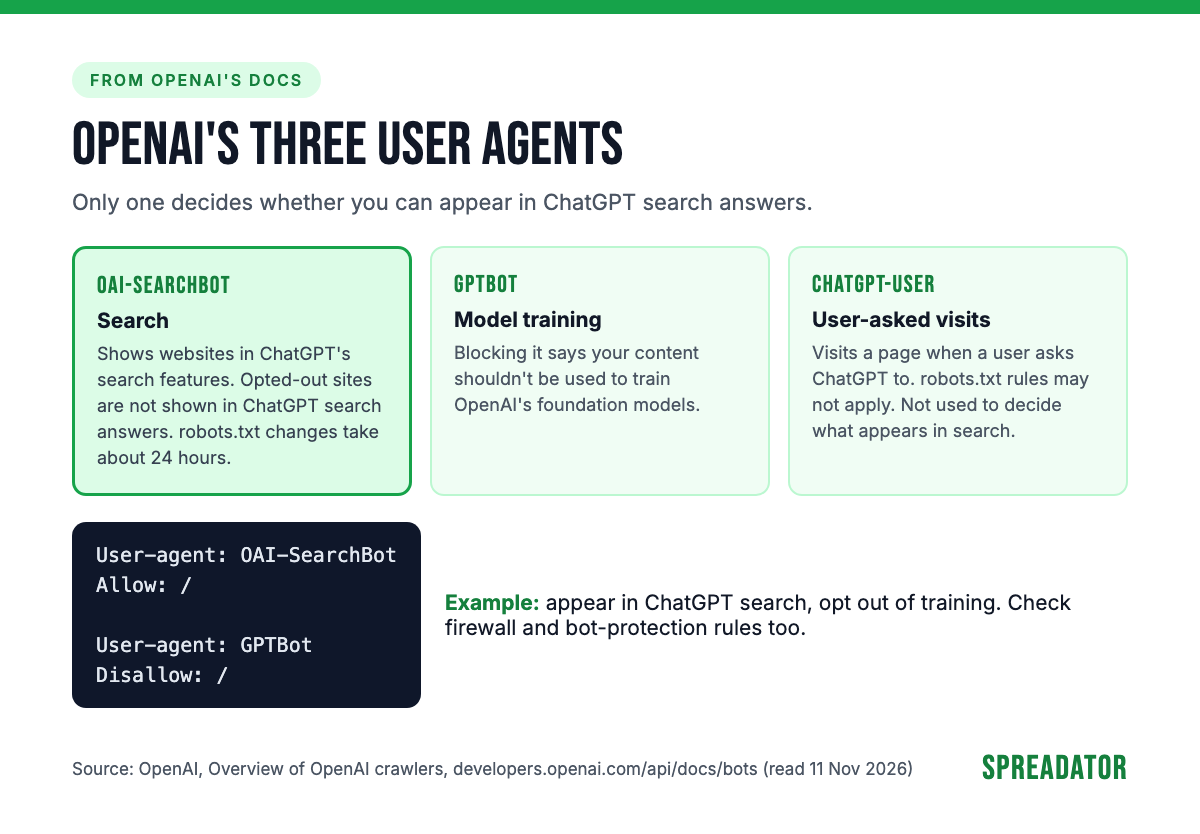
1. Let OAI-SearchBot in. OpenAI's search crawler is OAI-SearchBot, and "sites that are opted out of OAI-SearchBot will not be shown in ChatGPT search answers". OpenAI recommends allowing it in robots.txt and says changes can take about 24 hours to apply (OpenAI, Overview of OpenAI crawlers).
GPTBot is a different crawler, for model training, with its own robots.txt line. You can block GPTBot and still allow OAI-SearchBot. Check your robots.txt, and any firewall or bot-protection rules, for both.
2. Be findable through ChatGPT's search partners too. OpenAI says ChatGPT search "sometimes partners with other search providers", rewriting your question into targeted queries it sends them, and links Microsoft's privacy statement for how they process queries (OpenAI Help Center). For Enterprise and Edu workspaces it names Bing (OpenAI Help Center). Our reading: if your pages aren't indexed in Bing, fix that too, with Bing Webmaster Tools.
3. Put the answer first. ChatGPT turns a question into searches, reads results and writes an answer with links. A page that answers the question in its first two or three sentences is easier to quote than one that gets there after 400 words of background. The GEO guide covers what research says helps.
4. Keep your business facts consistent. Name, location, services, prices and who you serve should read the same on your site, your profiles and directories. An AI tool combining several sources can't cite a fact it finds three versions of.
5. Earn mentions on sites people trust. Answers about "best X for Y" lean on reviews, comparisons, industry media and forums. Being named there is PR and reputation work, not a setting on your site.
That answers the open question from the top. A page can rank on Google and still not be cited by ChatGPT if your site blocks OpenAI's search crawler, if ChatGPT's search partners don't index it, or if another page states the answer more plainly.
How to check if ChatGPT mentions you
Ask it what your buyers ask, and write down what comes back. It takes about 30 minutes:
- Write 10 questions a buyer asks before choosing someone like you, in their words ("best dentist for implants in Austin", "is X worth it for a small team").
- Ask each one in ChatGPT with search on, in a fresh chat, ideally logged out so your history doesn't shape the answer.
- For each answer, note the brands named and the pages cited, and whether you're one of them.
Repeat the same 10 questions every month. Answers vary from run to run, so one result proves little; the pattern over months is what counts. When you outgrow a spreadsheet, a tracking tool runs the questions on a schedule: our comparison of AI visibility tools sorts them by job.
Our take
Use ChatGPT every day for the busywork, and never for the judgement. Lists, groupings, first drafts of meta tags, JSON-LD and regex are faster with it. Deciding what to publish, what's true and what's different is still your job, and it's the part that ranks.
For showing up in ChatGPT, there's no trick. Check the crawler settings once. The rest is good SEO plus being talked about on sites people trust, which takes steady work, not a hack. Anyone selling a guaranteed spot in ChatGPT's answers is selling something OpenAI doesn't offer.
Who should bother now: businesses whose buyers research before they buy, such as B2B services, SaaS, healthcare and anything with a shortlist. If your site has basic SEO problems, fix those first; ChatGPT reads the same broken pages Google does.
FAQ
Can ChatGPT do SEO?
It can do parts of it: keyword ideas, grouping by intent, outlines, first drafts of meta tags and schema, and explaining technical errors. It can't tell you search volumes or what ranks today, and it can state wrong facts. Use it as an assistant and check its work.
How do I rank in ChatGPT?
Allow OpenAI's search crawler, OAI-SearchBot, in your robots.txt; OpenAI says sites that opt out aren't shown in ChatGPT search answers. Then answer questions plainly near the top of your pages, keep your business facts consistent everywhere, and earn mentions on sites people trust. No one can guarantee a place in its answers.
Is ChatGPT content bad for SEO?
Not because ChatGPT wrote it. Google says it rewards original, helpful content however it is produced, and treats many pages made mainly to manipulate rankings, with little value to users, as scaled content abuse. Unchecked, look-alike ChatGPT drafts at volume fall into that.
Does ChatGPT use Google or Bing?
OpenAI doesn't name Google. Its help page says ChatGPT search "sometimes partners with other search providers" and points to Microsoft's privacy statement; for Enterprise and Edu workspaces it names Bing. ChatGPT search also uses OpenAI's own crawler, OAI-SearchBot.
Is ChatGPT optimization different from SEO?
Mostly it builds on SEO: ChatGPT can only cite pages it can crawl and find. What it adds is more weight on clear, answer-first pages, consistent facts about your business and mentions on other sites. Both are part of AI search optimization.
Making ChatGPT SEO work for your brand
Start by finding out whether ChatGPT names you at all. Before you change a page, know where you stand.
That's what our AI visibility check covers: whether ChatGPT and other AI answers, including Google's AI results, name your business for your main searches, which sources they cite instead of you, and what to fix first.