
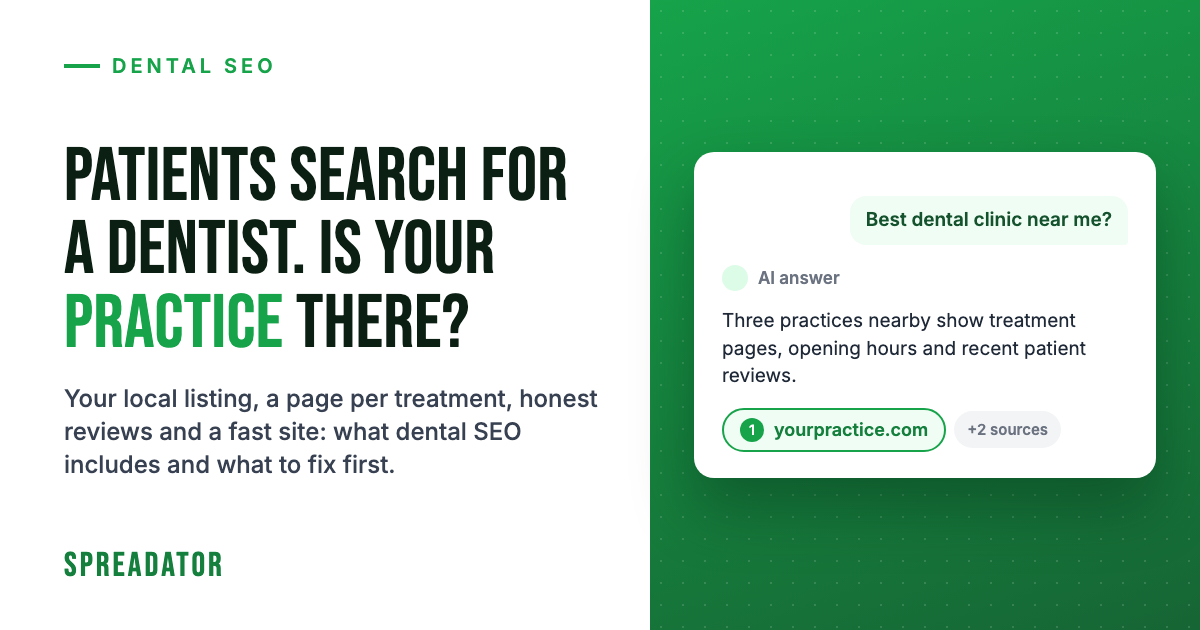
You ask ChatGPT for the best dental clinic in your city, and your practice isn't in the answer. A patient with a toothache does the same on Google, sees three practices on the map, and calls one of them. Dental SEO services are the work that puts your practice in those results: your listing in local search, a clear page for each treatment, a steady flow of honest reviews, and a site that loads fast on a phone. Here is what each piece involves and which to fix first.
If you only read this
- Most of what a practice needs from search is local: your Google Business Profile and your reviews do the most work.
- Give each treatment its own page, written for patients, not for other dentists.
- Google holds health pages to a higher standard: name the dentist who reviewed each one.
- Measure calls and booked appointments, not rankings.
Below: the six parts of dental SEO and what each involves, in the order we'd fix them, plus one open question: why a busy practice with good reviews can still be missing from AI answers.
What dental SEO services include
Dental SEO services cover six jobs. Agencies package them differently, but if a proposal leaves one out, ask why. On 11 Nov 2026, page 1 of Google (US) for "dental seo services" had one guide, four lists and four agency service pages, and each described a different mix of these six.
| Part | What it is | Who usually does it | How often |
|---|---|---|---|
| Local listings | Your Google Business Profile, plus the same name, address and phone on every directory | Practice manager, or an SEO specialist for several locations | Set up once, check monthly |
| Treatment pages | One page per treatment, written for patients | A writer, reviewed by a dentist | One or two pages a month until covered |
| Reviews | Asking every patient, replying to every review | Front desk and practice manager | Every day |
| Technical health | Speed on phones, pages Google can crawl, no broken links | A developer or technical SEO | Audit once, then quarterly |
| Content | Answers to the questions patients ask before they book | A writer, reviewed by a dentist | Monthly |
| AI answers | Making sure AI tools describe and cite your practice correctly | An SEO specialist | Check quarterly |
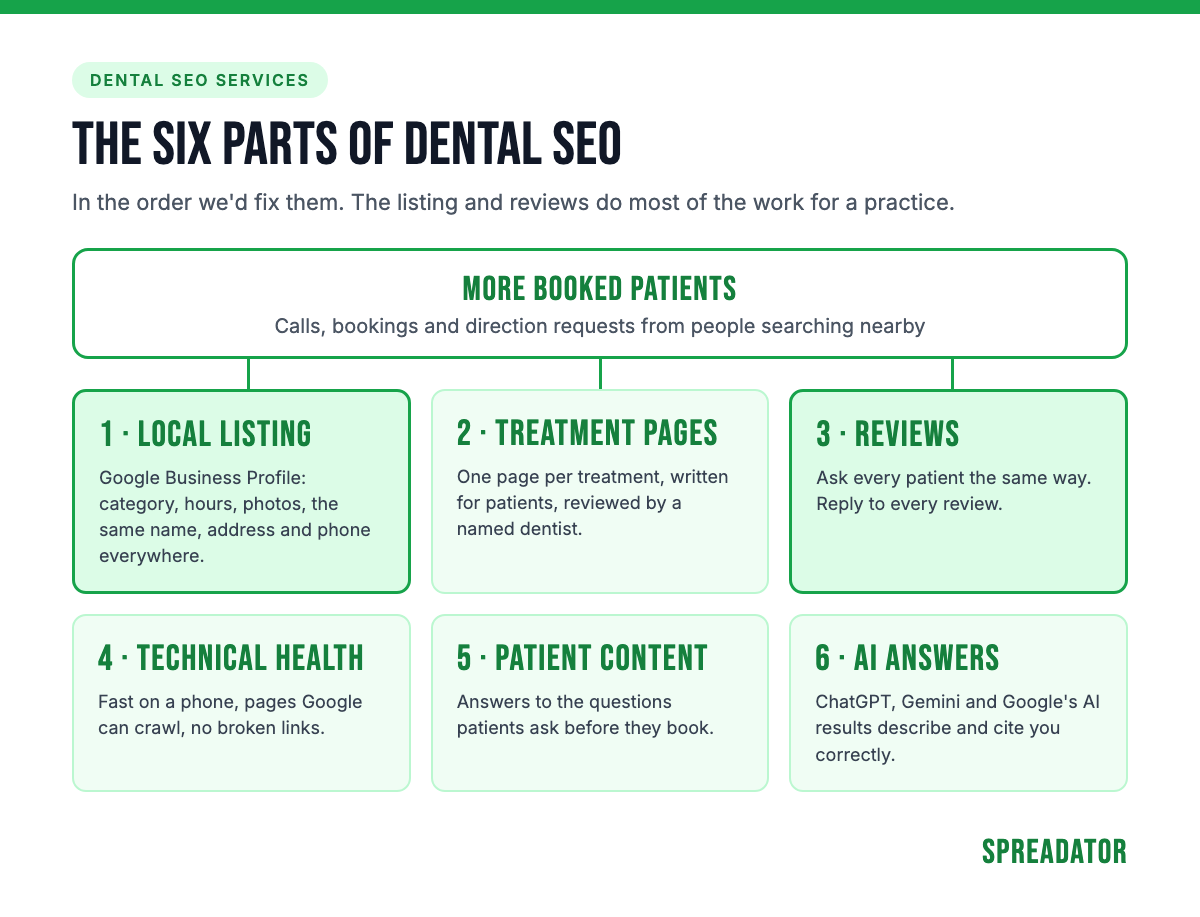
The order matters. A practice with a weak listing and no reviews won't be rescued by blog posts, however good they are.
Local search does most of the work for a practice
Patients choose a dentist close to home or work, so local SEO for dentists is where most of the return sits. When someone searches "dentist near me" or "emergency dentist", Google shows a map with a short list of practices before the ordinary results. Getting into that list depends mostly on your Google Business Profile and your reviews.
Your Google Business Profile. This is the practice's own listing on Google Maps and Search. Get these right first:
- Primary category: "Dentist", or the specialty that fits ("Orthodontist", "Pediatric dentist"), plus secondary categories for real services.
- Name, address and phone (NAP): exactly as they appear on your site and on every directory. Mismatches split your signals across what look like different businesses.
- Hours, including holiday hours, and whether you take emergency patients.
- Services and photos: list your treatments and add real photos of the office and team.
One location page per office. A group with three offices needs three pages on its site, each with its own address, map, hours, dentists and parking or access notes. A single "Locations" page listing all three gives Google nothing to match a local search to.
Our local business marketing service covers listings and location pages for practices with more than one office.
One page per treatment, written for patients
A patient searching "dental implants cost" or "clear aligners for adults" wants a page about that one treatment. Most practice sites have a single "Services" page with a line per treatment, and that page can't rank for any of them.
A good treatment page answers what the patient is asking before they call:
- What it is, in plain words.
- Who it suits, and who it doesn't.
- The steps, from first visit to follow-up.
- What affects the cost: materials, number of visits, insurance. You don't have to publish prices.
- Who does it here: the dentist's name, qualifications and a photo.
- The next step: a phone number and a booking button.
Before: "We offer dental implants, crowns, bridges and dentures." After: a page titled "Dental implants in [City]" that walks through the consultation, the implant, healing and the crown, names the dentist who places them and links to booking.
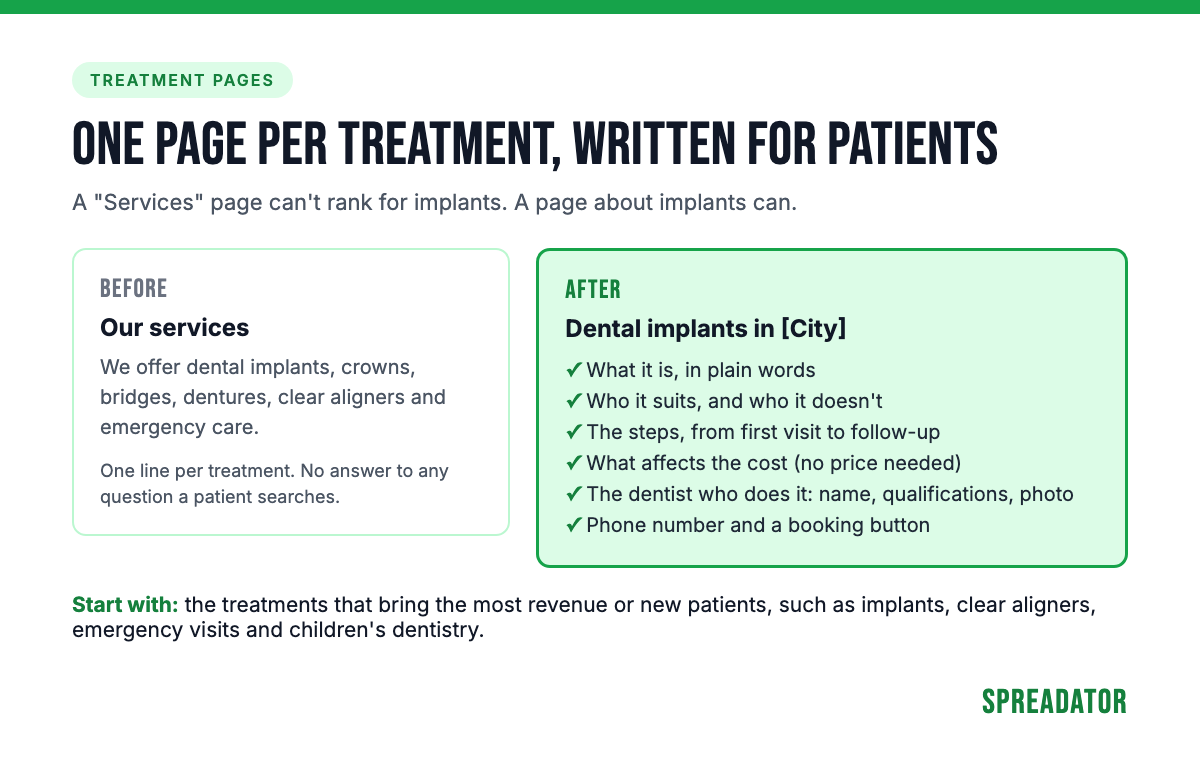
Start with the treatments that bring the most revenue or the most new patients: implants, clear aligners, emergency visits and children's dentistry are common choices.
Reviews: how to ask, and what the rules allow
Reviews do two jobs: they help your listing show up in local results, and they're what a patient reads before calling. The work is simple and daily: ask every patient, the same way, and reply to every review.
Ask everyone, not only the happy ones. Google's policy for Maps reviews says merchants may not "discourage or prohibit negative reviews, or selectively solicit positive reviews from customers" (Google, Prohibited and restricted content). The same policy removes reviews that were paid for or given in exchange for a discount or a free service.
The FTC's rule applies too. The FTC's rule on consumer reviews and testimonials was announced on 14 August 2024 and took effect on 21 October 2024 (FTC press release, 2024; FTC questions and answers). It bans fake reviews, reviews bought with incentives that depend on the review being positive, undisclosed reviews from staff, and threats used to get negative reviews taken down. It lets the FTC seek civil penalties from businesses that break it knowingly. Asking only happy patients isn't banned by the rule itself, but FTC staff say it could still break the FTC Act.
Reply carefully. Thank people for positive reviews. For a negative one, reply politely and offer to talk offline. Never confirm that the reviewer is a patient or mention their treatment, because patient privacy rules apply to replies too; check your wording with whoever handles HIPAA compliance at your practice.
Our reputation management team sets up review requests that follow these rules.
Health pages are held to a higher standard
Google treats health topics as "Your Money or Your Life" (YMYL): topics where poor content could harm someone's health, finances or safety. Its Search Quality Rater Guidelines (version dated 11 September 2025) list "YMYL Health or Safety" as one of these groups (Google Search Quality Rater Guidelines, 2025). Raters don't change rankings directly, but the guidelines show what Google wants its results to reward.
For a dental site, that means:
- Name who wrote or reviewed each treatment page, with their qualifications and a link to their bio.
- Keep facts current and date your reviews of each page.
- Don't overpromise. "Pain-free" and "perfect smile" claims read as marketing, not care.
Showing up in AI answers too
Patients now ask ChatGPT, Gemini and Google's AI results for a dentist, and those answers draw on the same things local search does: your listing, your reviews, your treatment pages and what other sites say about you. AI search optimization is the work of making your practice easy for those tools to find, trust and cite; our guide to generative engine optimization explains how it works.
This answers our open question. A practice with good reviews can still be missing from AI answers when its site doesn't say clearly what it does and where: no treatment pages, a vague "Services" page, an address that differs from its listing. The tool can't cite what it can't confirm.
What to measure
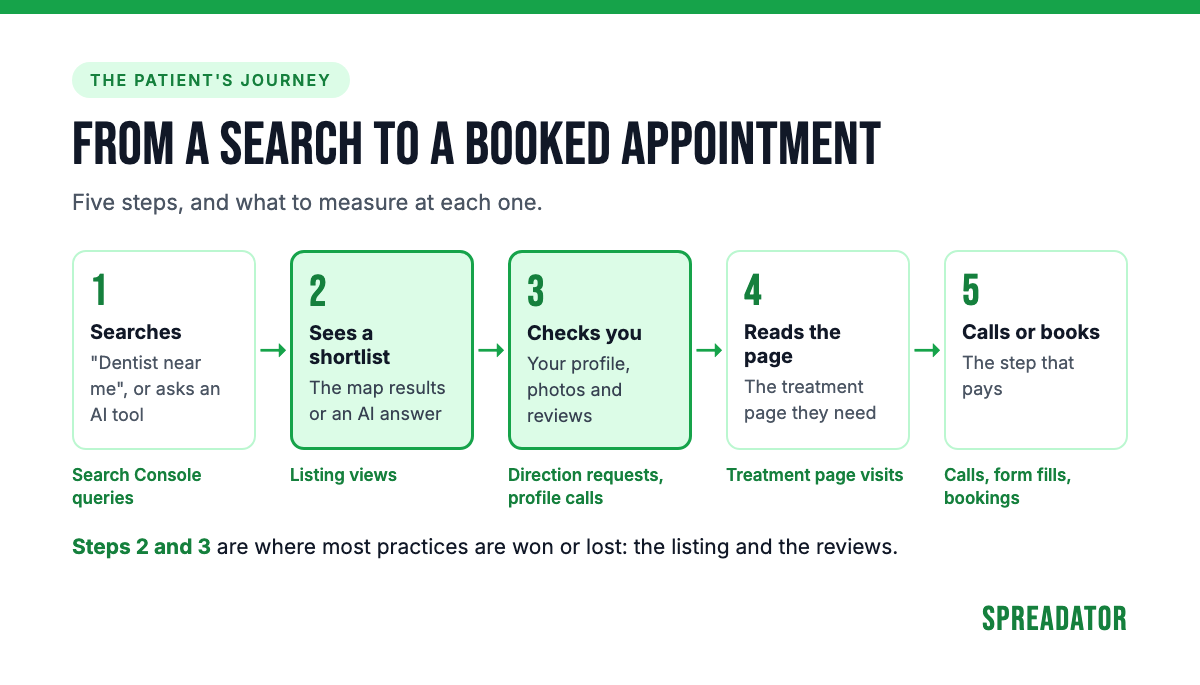
Rankings move every day and don't pay the bills. Track what a patient does:
- Calls from your Google Business Profile and your site (use a tracking number on the site).
- Booking-form submissions and online bookings.
- Direction requests from your listing.
- Search Console queries by treatment: are more people finding your implant page for implant searches?
Look at the trend month over month. One good week, or one bad one, tells you little.
Doing it yourself, or getting help
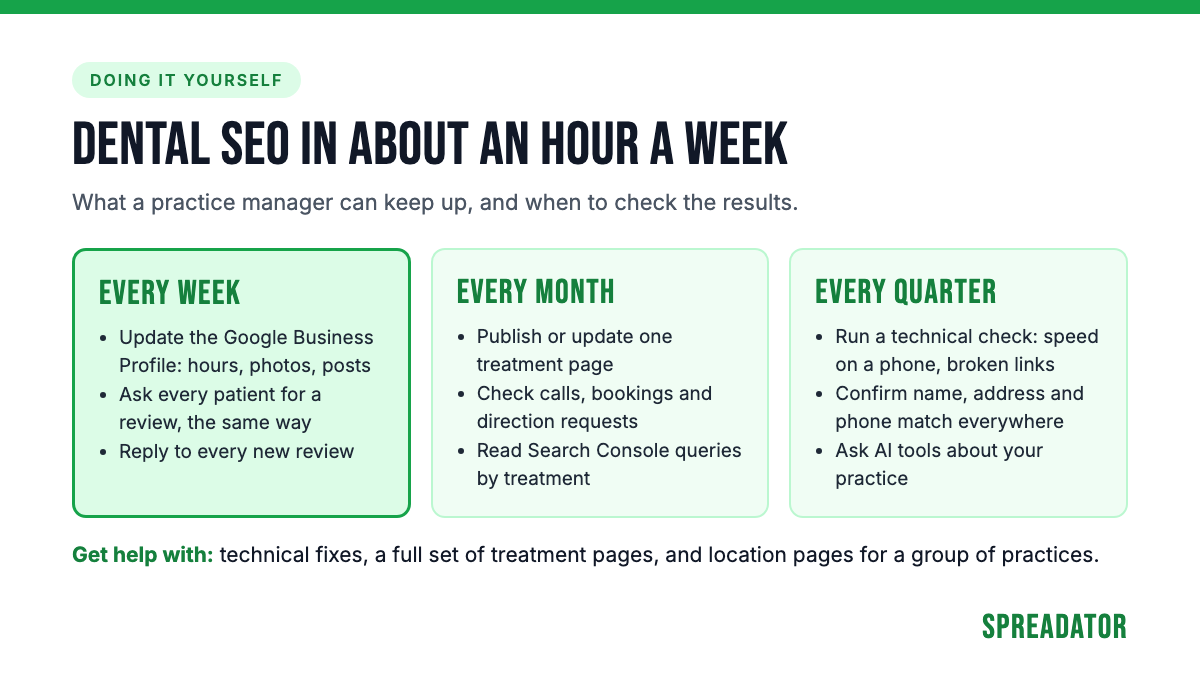
A practice manager can do a lot of dental SEO in about an hour a week. A specialist earns their fee on the parts that need technical skill or volume.
You can do: keep the Google Business Profile current, ask every patient for a review, reply to reviews, add photos, and check that your name, address and phone match everywhere.
You'll usually need help with: site speed and technical fixes, writing a set of treatment pages that a dentist then reviews, location pages for a group, and checking how AI tools describe you.
If you hire, look for a dental SEO expert who reports on calls and bookings, explains what they'll change and why, and doesn't promise a ranking.
Our take
A single practice with a well-kept Google Business Profile, a steady flow of reviews and a strong page for each of its main treatments often needs less than it's sold. In our judgement that's usually 6–8 treatment pages, not a blog post a week. If a proposal starts with content volume before your listing and treatment pages are right, ask for the order to be reversed.
A group of practices is different: each location needs its own listing, page and review flow, and someone has to keep them consistent. That's where a plan per location, and help, pays off.
FAQ
What do dental SEO services include?
Six parts: your local listing (Google Business Profile), a page per treatment, reviews, technical health, content that answers patients' questions, and how AI tools describe your practice. Most practices get the most from the first three.
What is local SEO for dentists?
It's the work of showing up in the map results when someone nearby searches for a dentist. It depends mostly on your Google Business Profile, consistent name, address and phone everywhere, reviews, and a page for each office.
How much does dental SEO cost?
It depends on how many locations you have, how many treatment pages you need, how much technical work your site needs, and how competitive your area is. Ask any agency to price each part separately so you can compare like with like, and to say which parts you could do yourself.
How long does dental SEO take to work?
Nobody can promise a date. Listing fixes and new reviews tend to show first, in calls and direction requests; treatment pages take longer to build up. Watch the monthly trend in calls and bookings, and judge the work on that.
Can I do dental SEO myself?
Much of it, yes. Keeping your listing current, asking for reviews and replying to them takes about an hour a week. Technical fixes, a full set of treatment pages and multi-location work usually need a specialist.
Getting dental SEO services for your practice
Tell us what you want to grow: more new patients, more implant cases, or a new location. We'll review your practice's search presence, from your listing and reviews to your treatment pages, and tell you what to fix first; see what our SEO service covers, then contact us.
Or ask us for an AI visibility check to see whether ChatGPT, Gemini and Google's AI results name your practice when patients ask for a dentist, and what to fix first.