
You search for a generative engine optimization agency and find lists of the "top 10". Almost every one is written by an agency, and some put themselves at #1. A list tells you who wrote it, not who is good. So this guide names no agencies. It gives you the checks to run on any of them, ours included.
Disclosure. Spreadator wrote this. We offer AI search optimization, so we are not neutral. That's why this guide names no agencies and gives you checks you can run on anyone.
If you only read this
- A GEO agency works to get your brand cited in AI answers. Good ones also do the SEO those answers depend on.
- Judge agencies on a method they show publicly and on reporting you can check, not on list rank.
- Red flags: guaranteed citations, prompts they won't share, no SEO basics.
- Get a baseline of where you appear in AI answers before you hire anyone.
Below: what the work is, five checks, the red flags, the questions to ask and how agencies charge. And one open question: what a "fake" GEO agency looks like. (Google suggests that exact search, "generative engine optimization agency fake", under this one.)
What a GEO agency does, and what it doesn't
A GEO agency works to get your brand named and linked inside answers that AI tools write, in ChatGPT, Gemini, Perplexity and Google's AI Overviews. Generative engine optimization is one part of AI search optimization; our guide to GEO explains the terms and how AI answers pick their sources.
The work itself is concrete. When we read the GEO pages of the agencies on Google's page 1 for this search (11 Nov 2026), their generative engine optimization services came down to some mix of these:
- Prompt research: the questions your buyers ask AI tools, in their words.
- Content changes: pages that answer those questions clearly enough to quote.
- Entity and schema work: making it obvious who you are, what you sell and who you serve.
- Third-party mentions: reviews, articles, roundups and forums that AI tools read.
- Tracking: which prompts name you, which name competitors, and what that traffic does on your site.
What it can't do is buy you a place in an organic AI answer. Paid placements exist, but they are ads. Google, for example, shows ads above, below and within AI Overviews and marks them with its "Sponsored" label (Google, Oct 2024). That is a paid search budget, not GEO. If an agency blurs the two, ask which one you are paying for. For what we include, see our generative engine optimization service, and run the five checks below on us as well.
Five checks to run on any GEO agency
Answer these from the agency's own website before the first call. They take a few minutes per agency and filter out most pitches:
- Method in public. Does its GEO page explain how it does the work, step by step, not just that it does it?
- Business numbers in reporting. Does it say it reports AI visibility next to leads, pipeline, conversions or revenue?
- SEO fundamentals. Does it also do the technical and content SEO that AI answers lean on?
- Scope in writing. Will it tell you, in writing, what one month buys in tasks?
- No guarantees. Does it avoid promising citations or rankings in AI tools, with or without a date?
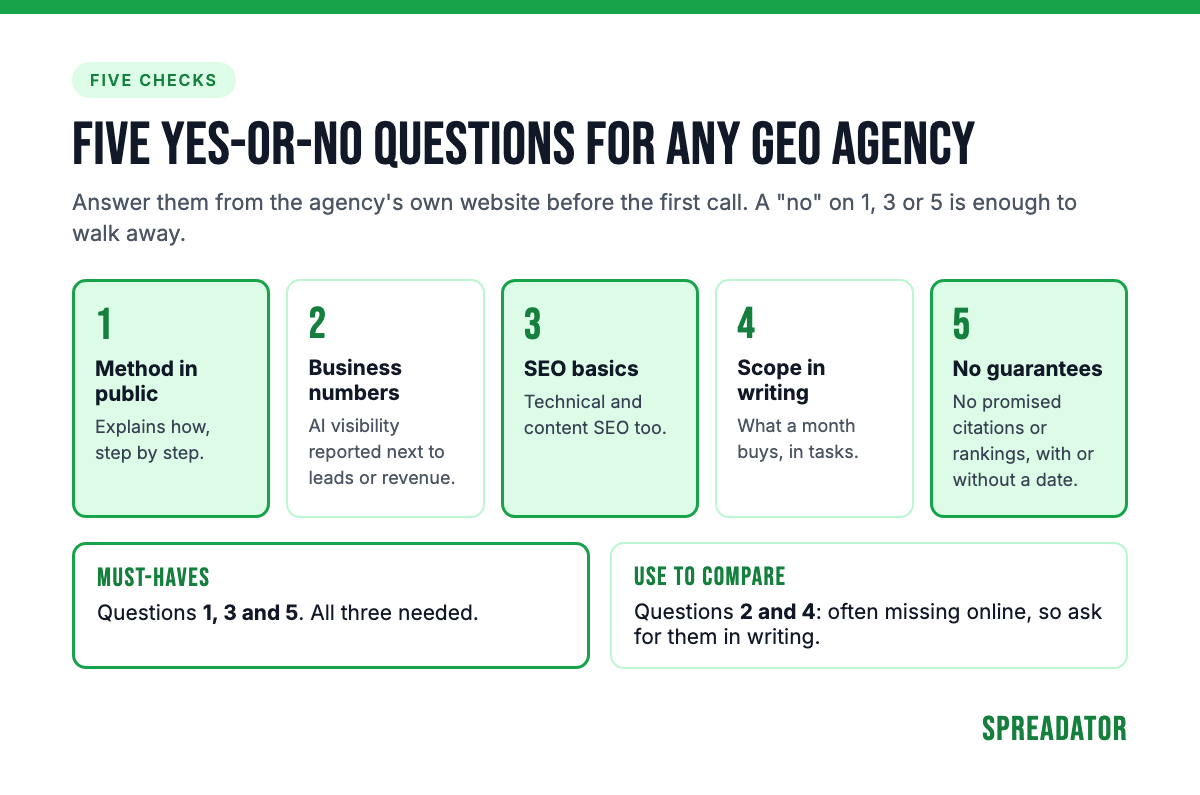
Treat 1, 3 and 5 as must-haves. A "no" on any of them is enough to walk away. Checks 2 and 4 are often missing from agency websites; of the 7 page-1 agency GEO pages that passed checks 1, 3 and 5 on 11 Nov 2026, 4 mentioned business numbers and none published a price. Ask for both in the proposal.
What a "fake" GEO agency looks like
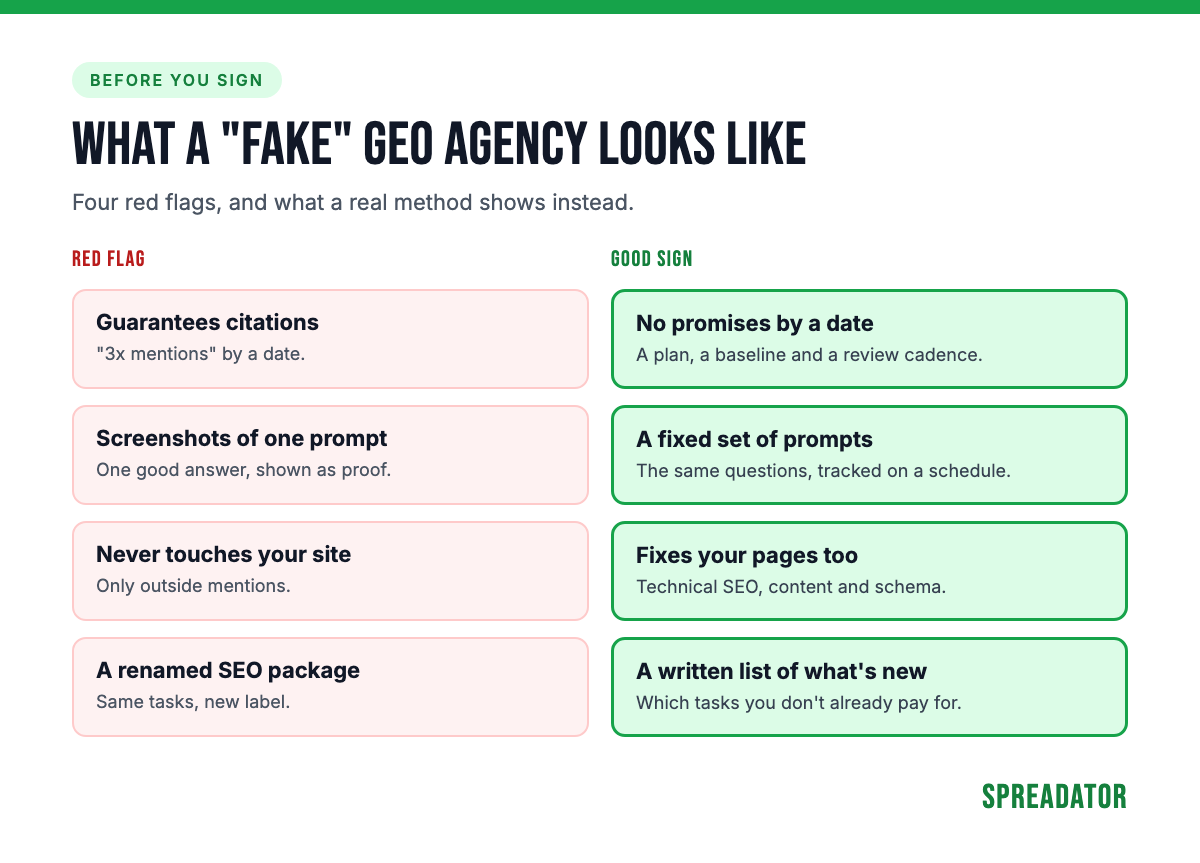
Most bad GEO is old SEO with a new invoice line, not fraud. But four signs should stop a deal:
- It guarantees citations. No one controls what ChatGPT or Google's AI writes. One agency's pricing page we checked says its team "can increase mentions by 3x in 1 month". Treat any promise like that as a red flag, with a date or without.
- It reports screenshots of one prompt. A single good answer proves little; answers can change from one chat to the next. You want the same set of prompts, tracked on a schedule.
- It never touches your site. If your pages are hard to crawl or vague about what you do, outside mentions won't carry you.
- It rebrands an old SEO package without saying what changed. Ask which tasks are new and which you already pay for.
Watch for self-awarded titles too. "The #1 GEO agency" usually means the agency wrote the list it tops. It tells you nothing about results.
Questions to ask before you sign
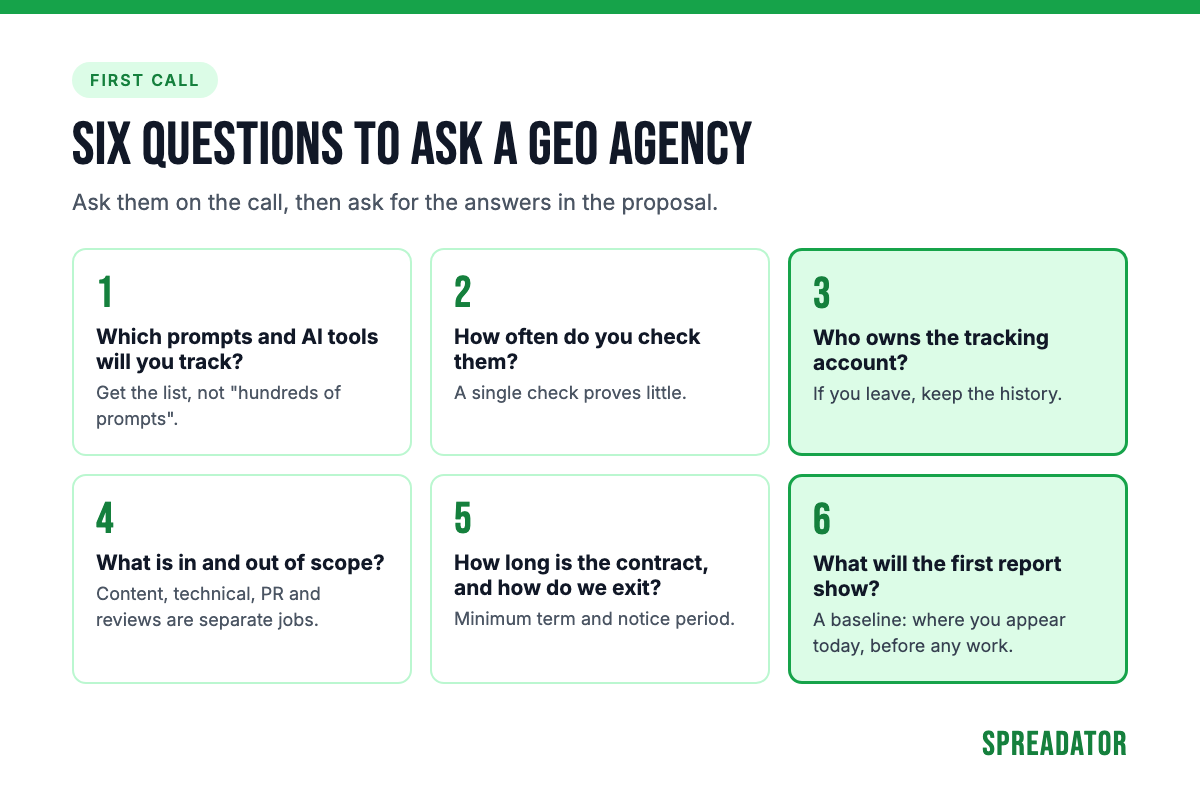
Six questions sort a real method from a pitch deck. Ask them on the first call and ask for the answers in the proposal:
- Which prompts and which AI tools will you track? Get the list, not "hundreds of prompts".
- How often do you check them? Monthly at least; a single check proves little, because answers vary from run to run.
- Who owns the tracking account? If you leave, you should keep the history.
- What is in scope and what is not? Content, technical fixes, PR and reviews are separate jobs.
- How long is the contract, and how do we exit? Know the minimum term and the notice period.
- What will the first report show? It should be a baseline: where you appear today, before any work.
What GEO agencies cost, and how they charge
Few GEO agencies publish prices, and the ones that do change them often, so we don't quote figures here. What you pay depends on how many buyer questions and AI tools are tracked, how much content and site work is included, and whether digital PR is part of it. The pricing models you will meet are:
- Audit first: a one-off check of where you appear in AI answers and what to fix, before any retainer.
- Project: a fixed scope, such as restructuring key pages and adding schema.
- Retainer: monthly content, PR and tracking, usually with a minimum term.
Whatever the model, ask for two or three written proposals with the same scope, and compare what one month buys in tasks, not in "visibility".
Our take: do you need a GEO specialist?
If your SEO is solid and your buyers research in chat tools, yes: hire a specialist, or an SEO agency with a real GEO method. That is a B2B buyer comparing vendors in ChatGPT, or a shopper asking Gemini which product to buy.
If your SEO is weak, hire for SEO first. AI tools read the same pages search engines do. A GEO-only shop can't fix pages that don't load, don't say what you sell, or don't rank anywhere. The agencies we read say much the same on their own pages: GEO sits on top of SEO fundamentals, not in place of them.
Either way, measure before you spend. With a baseline, you can judge every proposal against the same numbers.
FAQ
What does a generative engine optimization agency do?
It works to get your brand named and linked in AI-written answers. The work covers prompt research, content changes, entity and schema work, third-party mentions, and tracking which prompts name you. Good ones also do the SEO that AI answers depend on.
How do I know if a GEO agency is legit?
Check its own GEO page for a step-by-step method, reporting tied to leads or revenue, and SEO work. Walk away if it guarantees citations or rankings in AI tools, or reports only screenshots of single prompts.
GEO agency or SEO agency: which do I need?
If your SEO is weak, an SEO agency first; AI tools read the same pages search engines do. If your SEO is solid and buyers research in AI tools, look for an SEO agency with a GEO method or a GEO specialist.
How much does a GEO agency cost?
It depends on the scope: how many questions and AI tools are tracked, how much content and site work is included, and whether PR is part of it. Few agencies publish prices. Expect an audit, a project fee or a monthly retainer, and ask for the price and scope in writing.
How do you measure GEO results?
Track a fixed set of buyer prompts in each AI tool on a schedule and record who is named and which pages are cited. Then look at AI referral traffic and what it does on your site: leads, sales or sign-ups.
Choosing a generative engine optimization agency
Start with a baseline, then judge every agency against it. Before you hire anyone, find out where your brand appears, or doesn't, in AI answers and Google's AI results for your main searches.
That is what our AI visibility check covers: the searches that matter to you, who gets named instead of you, and what to fix first. It gives you a baseline to judge any agency by, us included. Our generative engine optimization service shows our own method, step by step, so you can run the five checks above on us too.