
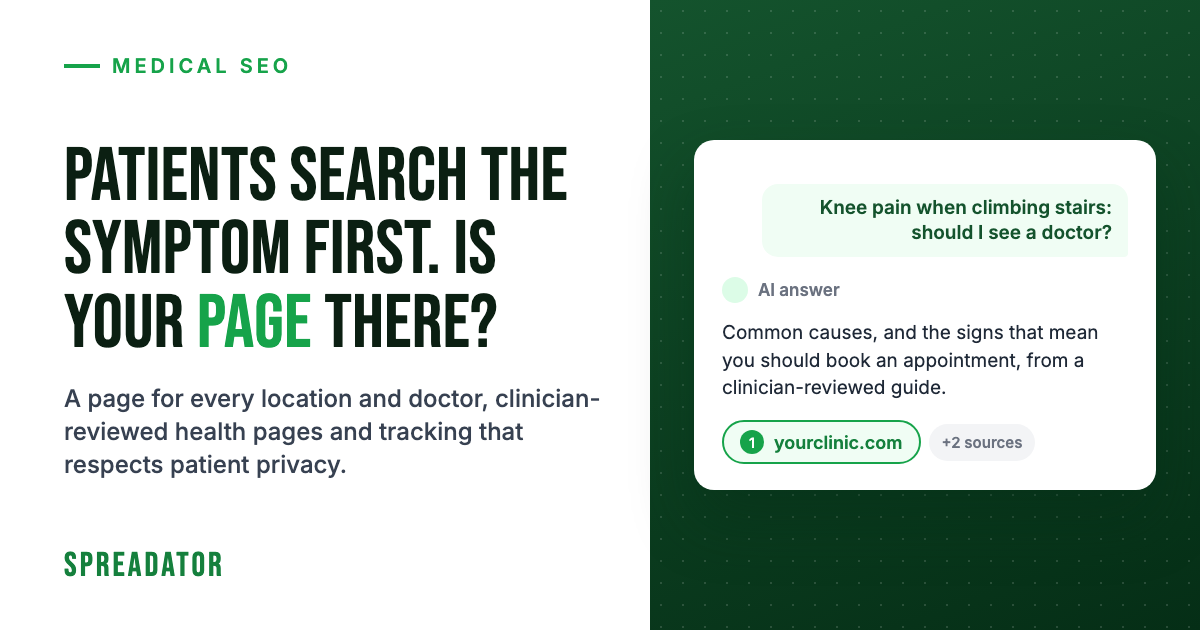
A patient types their symptom into Google, reads two pages, then searches for a doctor nearby. Medical SEO is the work of being found at both moments: a trustworthy page on the condition, and a clear listing for the doctor and the location. Health pages are held to a higher standard than most, and patient privacy limits how you can track visits. Here is what to do, in order.
If you only read this
- Give each location and each doctor their own page and listing.
- Have a named clinician review every condition and treatment page, and show the date.
- Check your analytics and ad pixels against HHS guidance before you track appointment pages.
- Measure appointment requests and calls, not rankings.
Below: the five parts of medical SEO, and one open question: why the tracking pixel on your booking page may be a bigger risk than your rankings.
What medical SEO covers
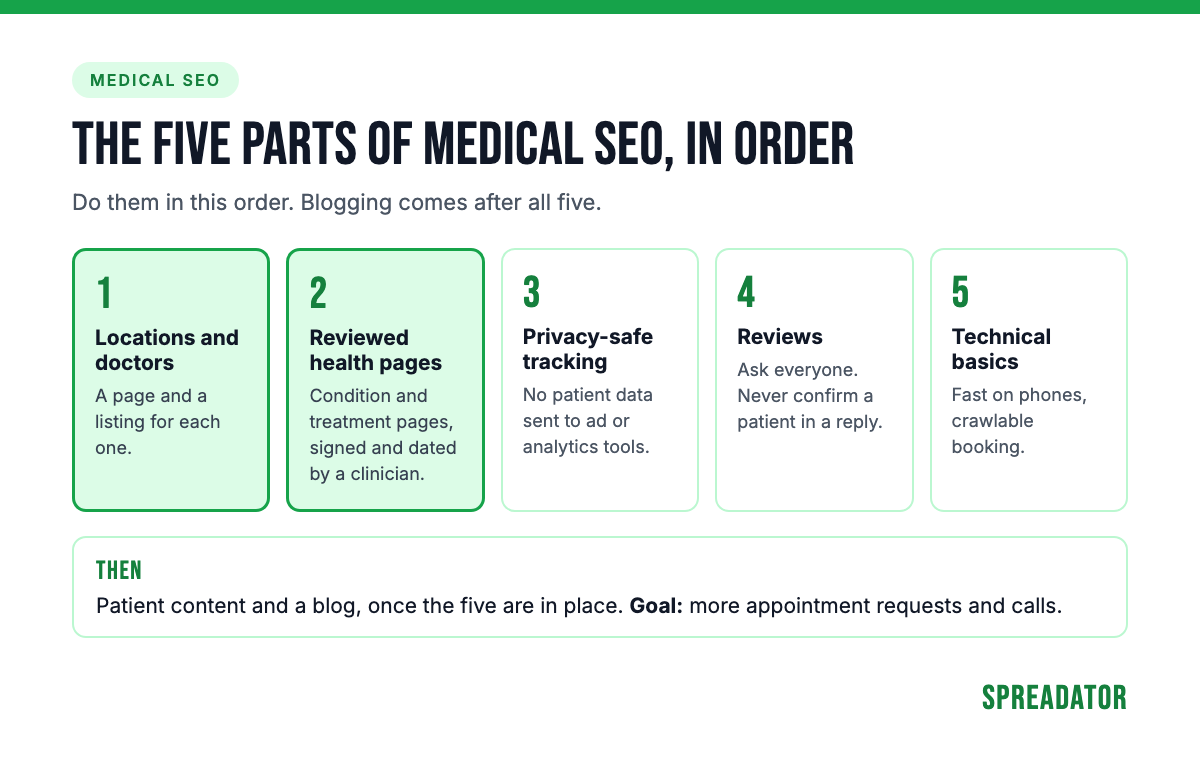
Medical SEO and healthcare SEO are the same work under two names. Most guides use them interchangeably, and so do we. For a practice or clinic, healthcare SEO services come down to five parts:
- Locations and doctors: one page and one listing for each.
- Health pages: condition and treatment pages, reviewed by a clinician.
- Tracking: analytics and ads set up without exposing patient data.
- Reviews: asked for consistently, answered carefully.
- Technical basics: a fast site that Google can crawl, booking widget included.
If you run a dental practice, our dental SEO guide covers the same ground for dentists. This guide is for medical practices, clinics and small groups.
Why Google judges health pages harder
Google puts health in its strictest category. Its Search Quality Rater Guidelines (version dated 11 September 2025) list "YMYL Health or Safety" among the "Your Money or Your Life" topics, where a poor page could harm someone (Google Search Quality Rater Guidelines, 2025). Raters judge these pages on experience, expertise, authoritativeness and trust (E-E-A-T), and the guidelines say "Trust is the most important member of the E-E-A-T family".
Raters don't change rankings directly. But the guidelines show what Google wants its results to reward. For a practice, that means three things a reader can see:
- Who wrote it and who reviewed it, with credentials and a link to their bio.
- When it was last reviewed, with a date on the page.
- Where the facts come from, with links to the sources you'd give a colleague.
One page and one listing for every location and doctor
Patients search for a doctor and a place, so give them one page for each. A clinic with three locations and twelve doctors needs three location pages and twelve doctor pages, not one "Our team" page.
Location pages. Each one carries its own address, phone number, hours, map, parking or access notes, and the doctors who practice there. Its name, address and phone must match its Google Business Profile exactly. A single "Locations" page listing all three gives Google nothing to match a local search to. Our local business marketing service sets up listings and location pages for groups.
Doctor pages. Name, photo, credentials, specialties, languages, the locations they see patients at, and a booking link. These pages also prove the "expertise" behind your health pages, because each reviewed page can link to its reviewer.
Schema markup helps Google read both. schema.org has a MedicalClinic type for a facility, Physician for a physician's office, and IndividualPhysician for a single doctor, with a practicesAt property that ties the doctor to each clinic (schema.org, read 11 Nov 2026). Mark up each location and each doctor page with the type that fits.
Condition and treatment pages, reviewed by clinicians
A patient searching a condition wants one page about that condition. Most practice sites have a "Services" page with a line per treatment, and it can't rank for any of them.
A good condition or treatment page follows the same shape:
- What it is, in plain words.
- Symptoms, and when to see someone, including when it's urgent.
- How you treat it here, and who does it.
- The reviewer's name and the review date, linked to their doctor page.
- Sources: the guidelines or studies the page relies on.
- The next step: a phone number and a booking link.
Before: "We treat diabetes, hypertension, thyroid disorders and more." After: a page titled "Type 2 diabetes care in [City]" that explains the condition, lists warning signs, walks through a first visit, names the endocrinologist who reviewed it on a stated date, and links to booking.
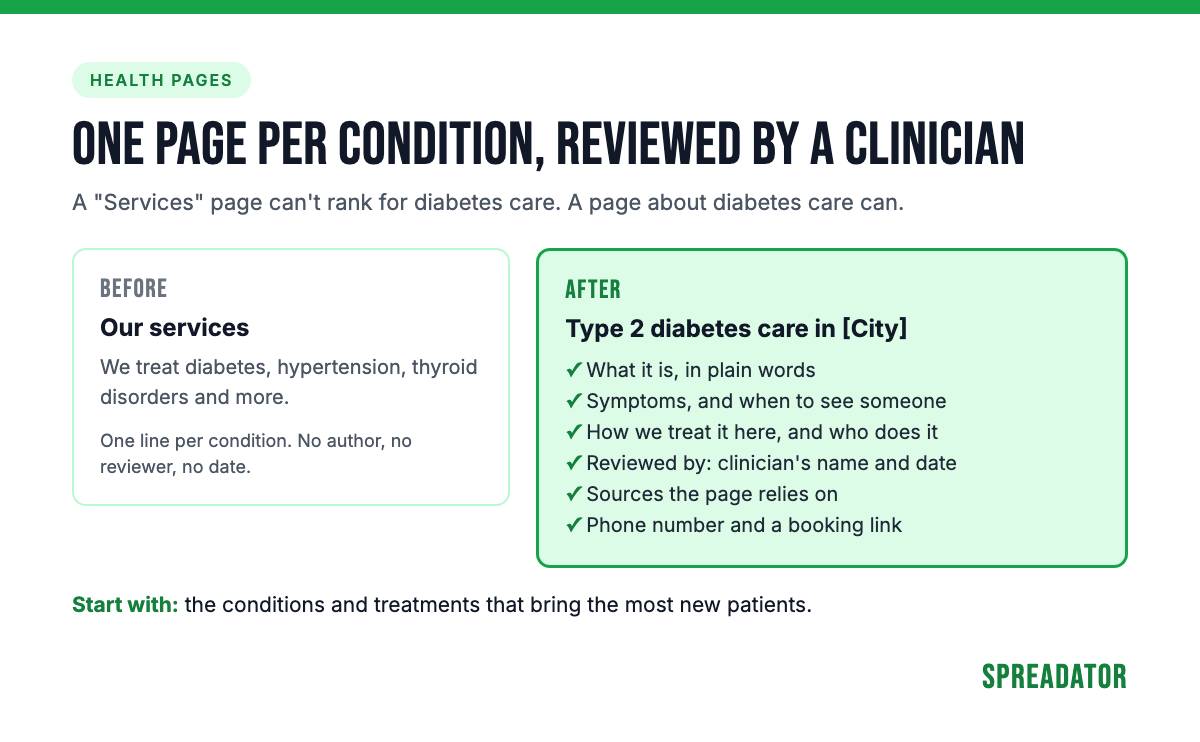
Start with the conditions and treatments that bring the most new patients, then add the rest. Each new page goes through the same clinician review.
Tracking without exposing patient data
This is where a practice can get into real trouble, and it's the answer to our open question. A ranking drop costs you visits. A tracking pixel that sends patient information to an ad platform can become a privacy violation. This section is not legal advice; check your setup with your privacy officer or counsel.
What HHS says. In December 2022 the HHS Office for Civil Rights issued a bulletin on tracking technologies (pixels, analytics and session-replay tools) used by HIPAA covered entities, updated in March 2024 (HHS OCR, Use of Online Tracking Technologies). It says practices may not use these tools in ways that disclose protected health information to the vendor without meeting HIPAA's rules, including a business associate agreement with vendors that collect it.
What the court changed. On 20 June 2024 a federal court in Texas (American Hospital Association v. Becerra) vacated one part of that bulletin: the view that an IP address plus a visit to a public page about a condition or a doctor counts as protected health information. HHS withdrew its appeal on 29 August 2024 (AHA, 2024). The rest of the bulletin still stands.
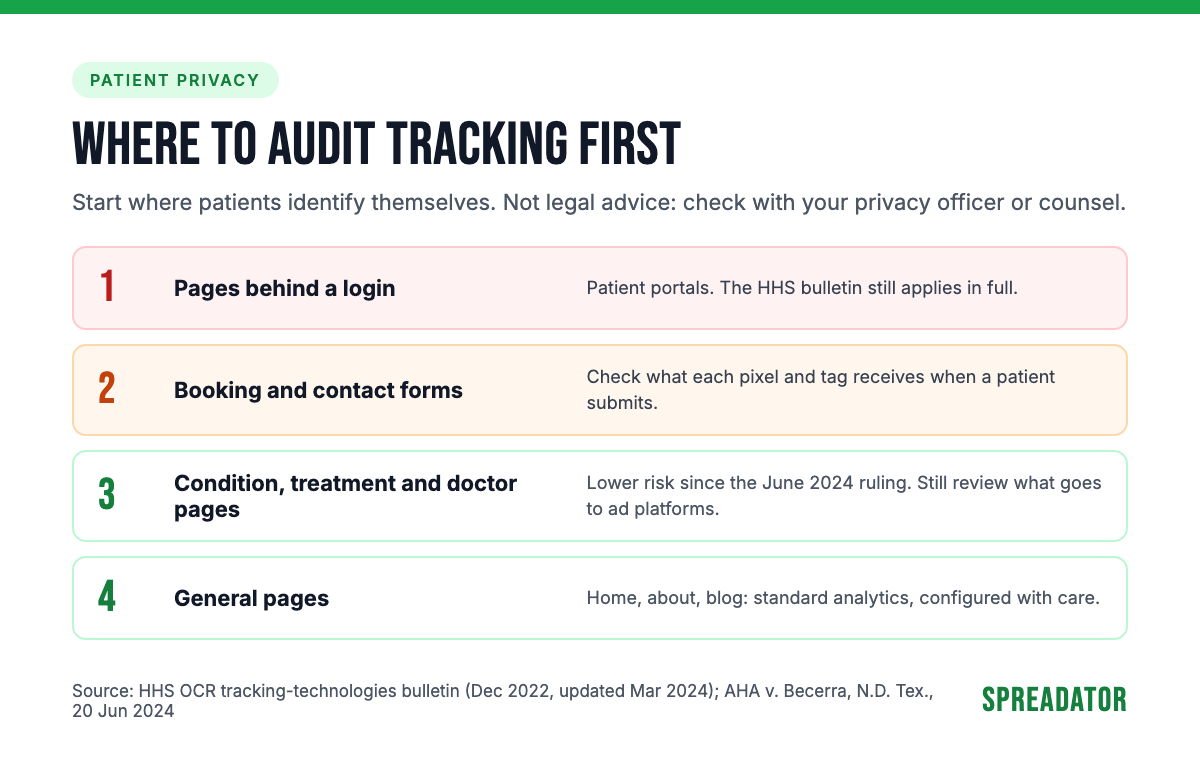
What that means on your site. Audit the pages where patients identify themselves first:
- Pages behind a login, such as a patient portal: the bulletin still applies in full.
- Booking and contact forms: check what each pixel and analytics tag receives when a patient submits a form.
- Condition, treatment and doctor pages: lower risk since the ruling, but review what you send to ad platforms.
- General pages (home, about, blog): standard analytics, configured with care.
Telehealth and health apps not covered by HIPAA have their own rule. The FTC's Health Breach Notification Rule covers many of them, and its guidance (July 2024) says sharing health information with an ad network without consent counts as a breach (FTC, Health Breach Notification Rule).
Reviews: ask everyone, reply carefully
Reviews help your listing show up and tell a patient what to expect. Ask every patient the same way, at the same point in the visit. Google's rules on asking for reviews and the FTC's rule on fake reviews apply to medical practices as they do to dentists; our dental SEO guide covers both.
The reply is where medical practices slip. HHS has settled with providers who disclosed patient information while replying to online reviews. In one case, a New Jersey psychiatry practice replied to a negative review with details of the patient's diagnosis and treatment (HHS OCR, 5 June 2023).
A safe reply thanks the reviewer, never confirms they are a patient, never mentions a condition or a visit, and offers a phone number to talk. Our reputation management team sets up review requests and reply templates that follow these rules.
Technical basics for clinic sites
Most clinic sites lose search traffic to the same three problems:
- Slow pages on phones. Patients search on their phones, often in a hurry. Heavy images and sliders on the home page are the usual cause.
- Booking widgets Google can't read. A third-party booking tool in a frame or a pop-up often hides your services and doctors from Google. Keep that information as text on your own pages, with the widget as the last step.
- Duplicate location pages. Ten pages with the same text and a different city name can look like doorway pages to Google. Each location page needs its own details: doctors, hours, services and directions.
AI answers and health searches
Patients also ask ChatGPT, Gemini and Google's AI results about symptoms and doctors. Those tools lean on pages they can trust and on what other sites say about you: your listings, your reviews and your reviewed health pages. AI search optimization is the work of making your practice easy for those tools to find, trust and cite. Our guide to generative engine optimization explains how AI answers pick their sources.
The good news: the work above is most of it. A reviewed page with a named doctor and a clear location is what an AI answer can quote.
What to measure
Rankings move every day and don't fill appointment slots. Track what a patient does:
- Appointment requests from your site and your booking tool.
- Calls from your Google Business Profile and your site.
- Direction requests from each location's listing.
- Search Console queries by condition and by location: are more people finding your diabetes page for diabetes searches near you?
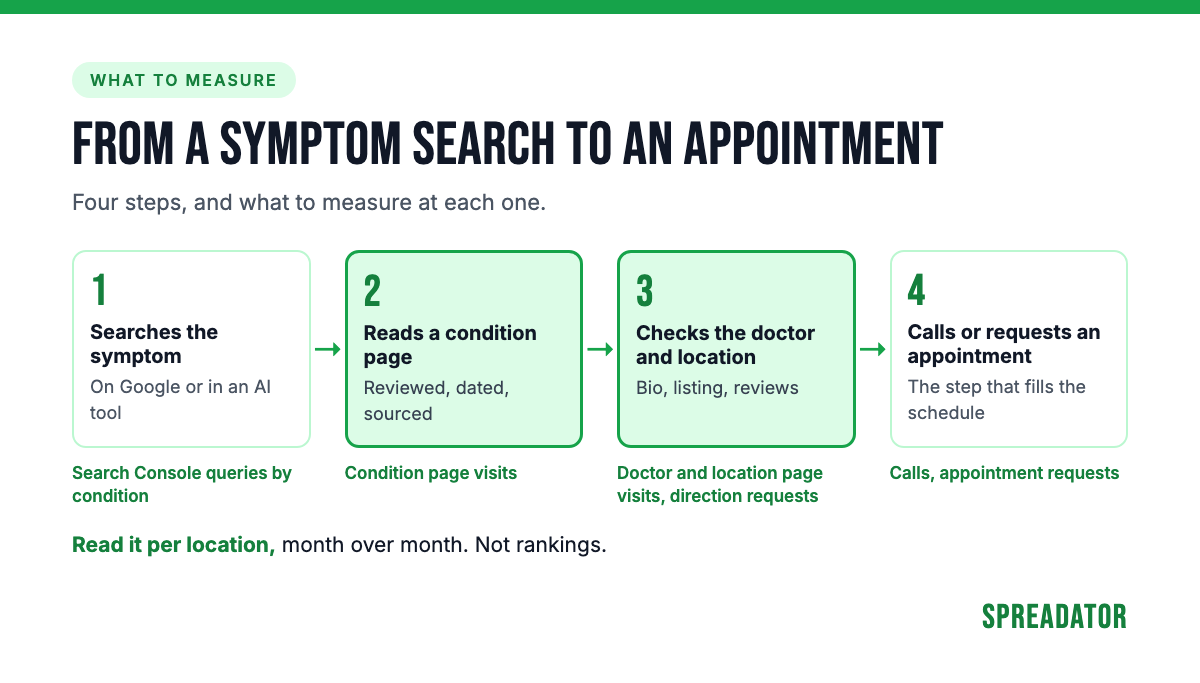
Look at the trend month over month, per location. One good week, or one bad one, tells you little.
Our take
For most practices the order is: listings, then doctor and treatment pages, then reviews, then content. A blog comes last. If a proposal starts with "four blog posts a month" while your locations share one page and your doctors have no bios, ask for the order to be reversed.
Specialists with high-value procedures can justify condition content earlier. A spine surgeon or a fertility clinic competes on trust in detailed information, and patients read a lot before they book.
So is healthcare SEO worth it? In our judgement, yes, for a practice that will keep its listings current and have clinicians review its pages. It is not worth it for a practice that wants traffic but won't give a doctor time to review what's published. And whatever you do, fix your tracking first.
FAQ
What is medical SEO?
It's the work of helping patients find your practice in search: a page and listing for each location and doctor, clinician-reviewed condition and treatment pages, reviews, a fast site, and tracking that protects patient data.
Is healthcare SEO worth the investment?
For a practice that keeps its listings current and has clinicians review its health pages, usually yes, because patients search before they book. Judge it on appointment requests and calls, month over month, not on rankings.
Does HIPAA affect SEO and analytics?
Yes, mostly through tracking. HHS guidance limits what pixels and analytics may collect on pages where patients can be identified, such as patient portals and booking forms. A June 2024 court ruling narrowed that guidance for public pages. Check your setup with your privacy officer or counsel.
How do doctors get more patients from Google?
A complete Google Business Profile for each location, a page for each doctor and each main treatment, steady reviews, and a site that loads fast on phones. Measure calls and appointment requests to see what works.
What's the difference between medical SEO and healthcare SEO?
None in practice. Both describe the same work for practices, clinics and hospitals, and most guides use the two names interchangeably.
Getting medical SEO help for your practice
Tell us what you want to grow: a new location, a specialty, or more booked appointments. We'll review your practice's search presence, from your listings and doctor pages to your health pages and tracking, and tell you what to fix first. See what our SEO service covers, then contact us.
Or ask us for an AI visibility check to see whether ChatGPT, Gemini and Google's AI results name your practice when patients ask, and what to fix first.