
You ask ChatGPT, Gemini or Google's AI Overview a question about your field, and the answer names a competitor, not you. Generative engine optimization (GEO) is the work of making your pages easy for those AI tools to find, understand and cite. It is one part of what we call AI search optimization, and most of it builds on SEO you may already do.
If you only read this
- GEO means making your content easy for AI answer engines to find, trust and cite.
- It is one part of AI search optimization, next to AEO and AI SEO (defined below).
- AI answers can only use pages they can reach. Google says its AI features need nothing beyond normal SEO best practice, so the basics come first.
- Check where you stand by asking the questions your buyers ask, in the tools they use.
Below: the three terms in one picture, what research says actually helps, and one open question: why a page that ranks on Google can still be left out of the AI answer.
GEO in one sentence, and where it fits
Generative engine optimization is the practice of shaping your pages and your reputation so that AI tools that write answers (ChatGPT, Gemini, Perplexity, Google's AI Overviews) pick your content and cite it. In the UK it's often spelled generative engine optimisation; it's the same thing.
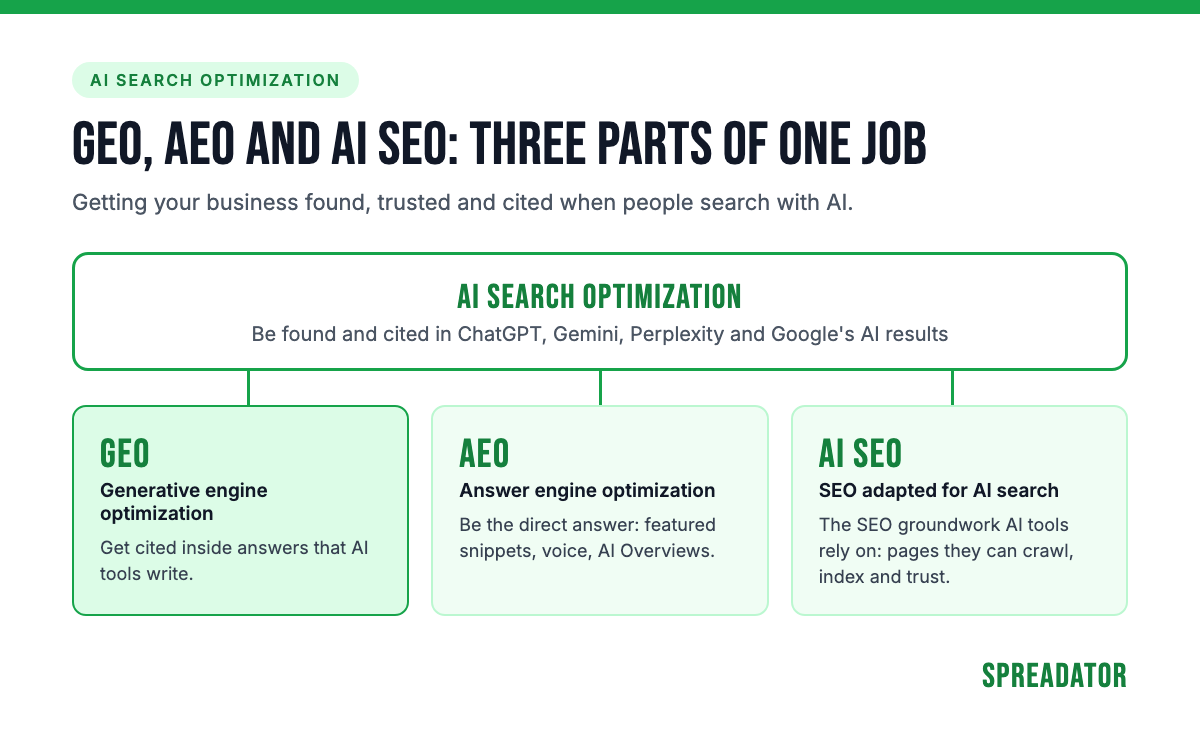
GEO sits under a wider job, AI search optimization, alongside two related terms:
- GEO (generative engine optimization): get cited inside answers that AI tools write.
- AEO (answer engine optimization): be the direct answer: featured snippets, People also ask, voice assistants and AI Overviews.
- AI SEO: the SEO groundwork AI tools rely on: pages they can crawl, index and trust.
The terms get mixed up, even by Google. On 11 Nov 2026 we searched "generative engine optimization" in India and the UK. Google's own AI Overview said GEO is "also known as answer engine optimization (AEO)" in one, and "also called Answer Engine Optimization (AEO)" in the other.
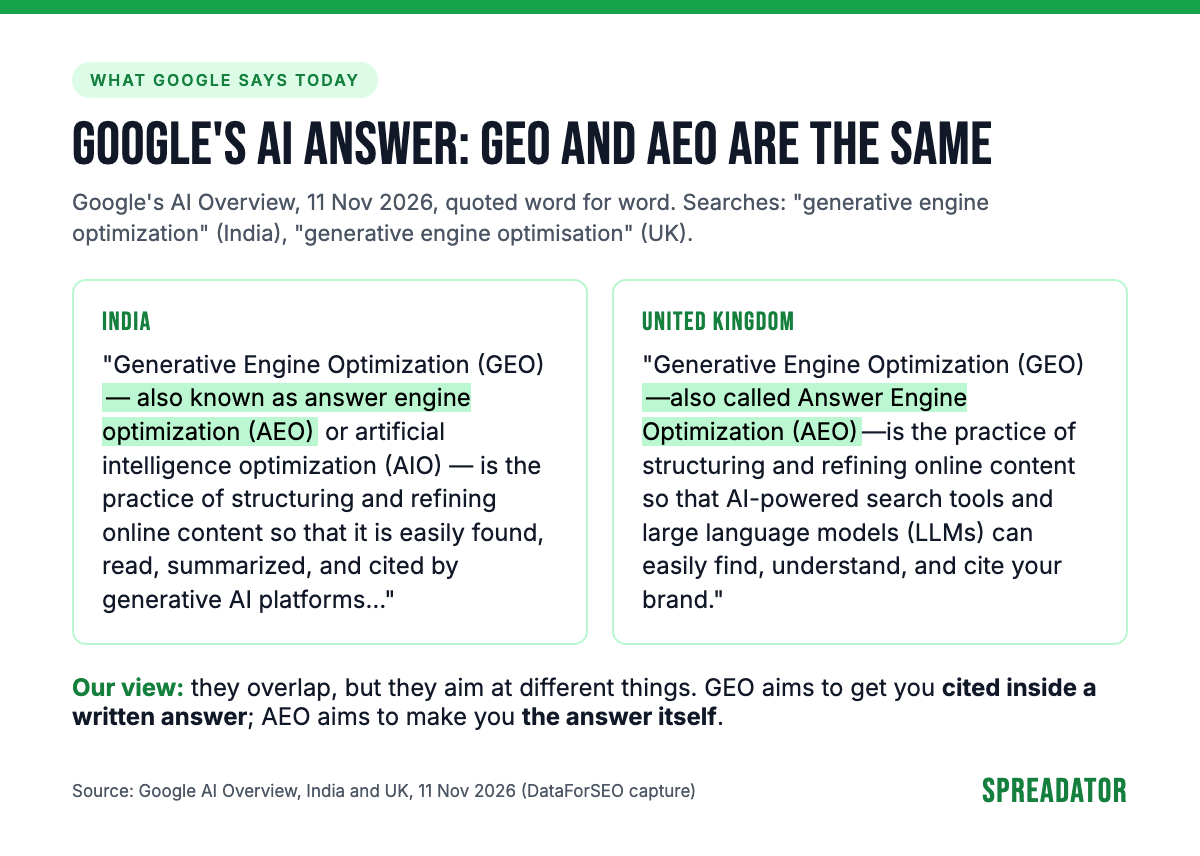
They overlap, but they aim at different things. AEO wants your page to be the answer. GEO wants your business named and linked inside an answer the AI writes from several sources. Our generative engine optimization service covers the first; answer engine optimization covers the second.
How AI answers choose what to cite
An AI answer is only as good as the pages it reads. The steps differ by tool, but the shape is the same: the tool takes the question, finds pages, writes a summary from the clearest ones and shows a few of them as citations.
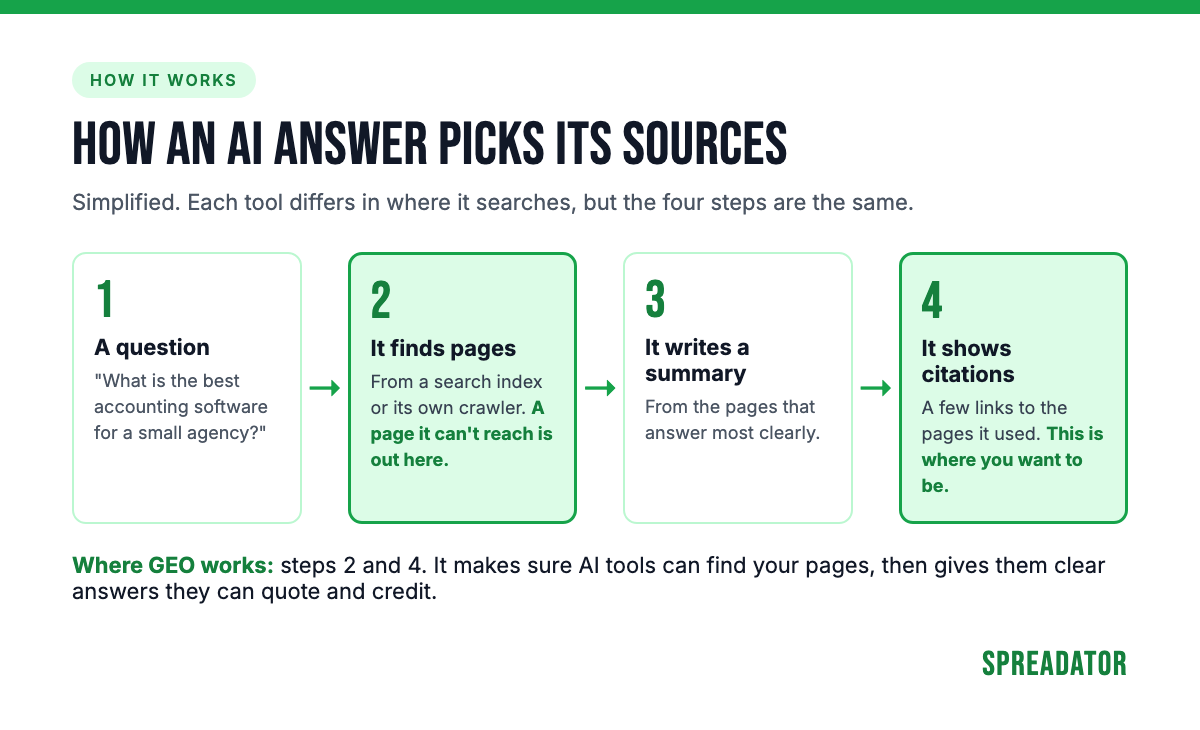
Two official sources show where the gate is:
- Google: to appear as a supporting link in AI Overviews or AI Mode, "a page must be indexed and eligible to be shown in Google Search with a snippet." Google adds that "there are no additional requirements to appear in AI Overviews or AI Mode, nor other special optimizations necessary." (Google Search Central, AI features and your website)
- OpenAI: ChatGPT's search uses a crawler called OAI-SearchBot, and "sites that are opted out of OAI-SearchBot will not be shown in ChatGPT search answers." (OpenAI, Overview of OpenAI crawlers)
That answers the open question from the top. A page can rank on Google and still be missing from ChatGPT's answers if your site blocks OpenAI's search crawler, or if the page buries its answer so deep that another page is easier to quote.
What the research says helps
The term comes from a 2023 research paper, "GEO: Generative Engine Optimization" (Aggarwal and others, arXiv 2311.09735, accepted at KDD 2024). The authors rewrote web pages in different ways and measured how much of each page showed up in AI-generated answers.
Their headline: GEO "can boost visibility by up to 40% in generative engine responses." What worked and what didn't:
| Change to the page | What the paper found |
|---|---|
| Cite sources, add quotations, add statistics | The strongest methods: a relative improvement of 30–40% on their main visibility measure |
| Make it fluent and easy to understand | A smaller boost of 15–30% |
| Keyword stuffing | "Little to no improvement"; on Perplexity it did 10% worse than the original page |
This was a lab study on its own test set, so treat the numbers as direction, not a forecast for your site. The direction is useful, though: AI tools reward pages that back up their claims, not pages that repeat a keyword.
What GEO changes on your site, and what stays plain SEO
Most of the work is SEO you'd do anyway. A few things matter more when an AI is the reader.
| Stays plain SEO | Matters more for GEO |
|---|---|
| Pages crawlers can reach, including AI search crawlers in your robots.txt | The answer in the first two or three sentences, before the detail |
| Pages indexed and eligible for a snippet in Google | Facts with named sources and dates, so a summary can repeat them safely |
| Fast, server-rendered pages | Clear facts about your business: who you are, where you work, what you do, said the same way everywhere |
| Links from other sites | Mentions on the sites AI tools read: directories, reviews, industry media |
| Clear headings and internal links | Headings phrased as the questions buyers ask |
If you only do one thing this month, check your robots.txt for the crawlers of the AI tools your buyers use, then rewrite the opening of your three most important pages so each one answers its question in plain words first.
Will GEO replace SEO?
No. Google says the best practices for SEO "remain relevant for AI features in Google Search," and the pages AI tools cite still have to be found and indexed first. GEO is SEO plus a few habits that make your pages easier to quote. If your site isn't indexed well, GEO won't fix it; start there.
How to see where you stand today
You don't need a tool to start. Take 15 minutes:
- Write down 10 questions your buyers ask before they buy, in their own words.
- Ask each one in 3 AI tools: ChatGPT, Gemini and Google's AI Overview (or Perplexity), each in a fresh chat.
- For each of the 30 answers, note which brands are named and which pages are cited, and whether you're in it.
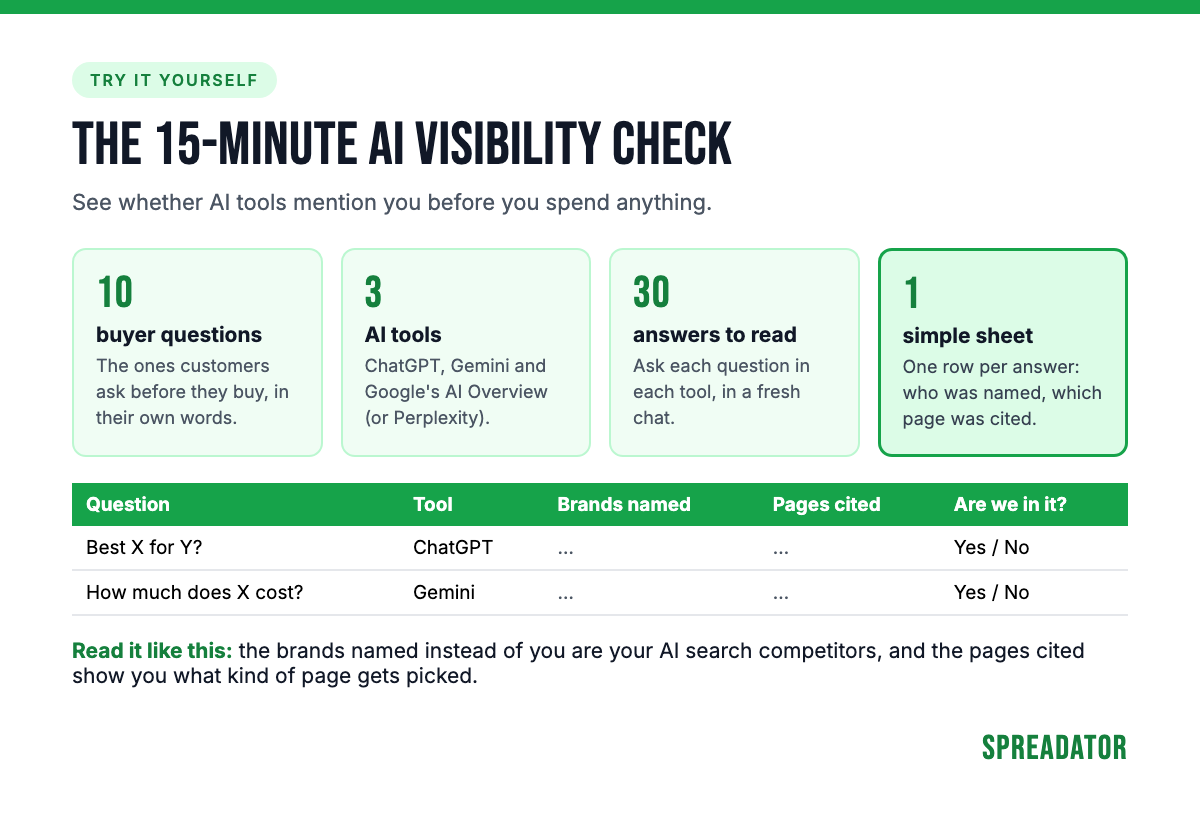
The brands named instead of you are your competitors in AI search. The pages cited show you what kind of page gets picked: a guide, a comparison, a directory listing. AI answers change from one run to the next, so repeat the same questions every month rather than reading one result too closely.
Our take: who should start now, and who can wait
Start now if your buyers research before they buy: B2B services, SaaS, healthcare, anything with a shortlist and a comparison. Those are exactly the questions people now put to AI tools.
Wait if your site has bigger problems: pages not indexed, slow or broken templates, no clear service pages. GEO sits on top of SEO. Fix the base first, then work on being quoted.
Either way, don't buy GEO as a separate product from someone who can't show you the 30 answers above. The check is cheap, and it tells you whether you have a problem at all.
FAQ
Will GEO replace SEO?
No. Google says SEO best practices remain relevant for its AI features, and AI tools can only cite pages they can find and index. GEO adds habits on top of SEO: answer first, back up claims with sources, and get your business described consistently on other sites.
What is generative engine optimization?
Generative engine optimization (GEO) is the practice of making your content easy for AI tools that write answers, such as ChatGPT, Gemini, Perplexity and Google's AI Overviews, to find, trust and cite. It is one part of AI search optimization.
What is the best tool for generative engine optimization?
There isn't one tool that does GEO for you. Tracking tools show where your brand appears in AI answers; the work itself is content, site structure and mentions on other sites. Start with the 15-minute check above, then add a tracking tool if you need to follow many questions every month.
How do I learn GEO as a beginner?
Learn SEO basics first: crawling, indexing, clear pages and links. Then read Google's guide to its AI features and the 2023 GEO paper, and run the 15-minute check on your own business every month to see what changes.
Is GEO the same as AEO?
They overlap but aren't the same. AEO aims to make your page the direct answer, such as a featured snippet or a voice answer. GEO aims to get your business cited inside an answer an AI writes from several sources. Both are parts of AI search optimization.
Getting started with generative engine optimization
If you'd rather not run the check yourself, ask us for an AI visibility check. We test the questions your buyers ask across ChatGPT, Gemini, Perplexity and Google's AI results, show you who is cited instead of you and why, and give you a ranked list of what to fix first. See our generative engine optimization service, the wider AI search optimization service and answer engine optimization, or ask us for an AI visibility check.